MIGRANT PROTEST: Residents take to the streets over a proposal to house more than 1,250 migrants near a UK market town . HYN


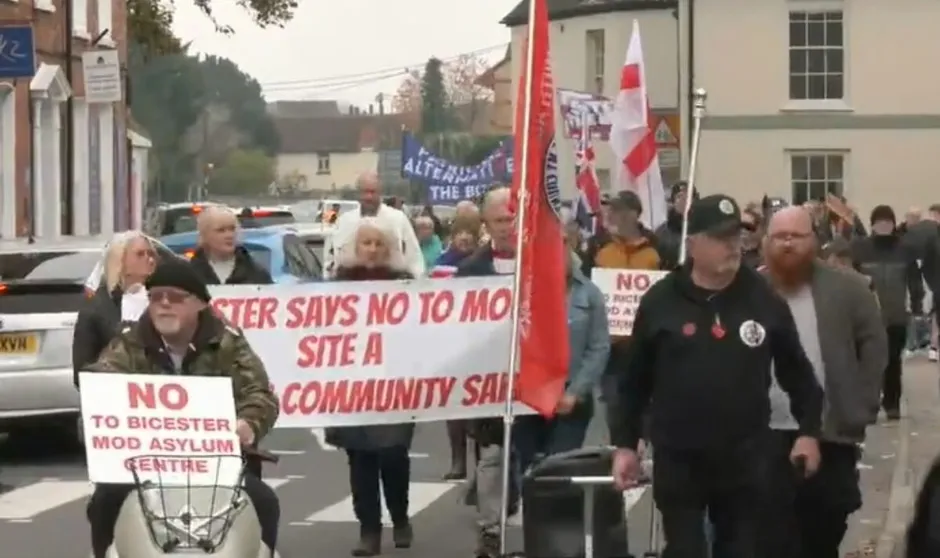
Thousands marched in a UK market town yesterday against plans to house more than 1,200 migrants nearby.
The Government wants to move the asylum seekers into the disused MoD Bicester outside the town of the same name, and the small hamlet of Piddington, in Oxfordshire.
An Urgent Crown Development application for Site A published in September read: “The Proposed Development comprises the retention and change of use of Building A6, the demolition of existing buildings and structures, the erection of new modular accommodation, and the provision of space for associated health and welfare facilities, site infrastructure, wastewater treatment plant, roads, access ways, security infrastructure, parking, staff accommodation and facilities, and open space and recreational areas, to accommodate up to 1,256 service users.”
The Home Office’s cover letter dated July 6 stated that the Home Secretary has powers under law to “provide support to asylum seekers who would otherwise be destitute”.
“This includes the provision of accommodation and/or subsistence under section 95 of the Immigration and Asylum Act 1999, temporary support under section 98 while an application under section 95 is under consideration, and support under section 4(2) for certain refused asylum seekers who meet the relevant statutory criteria,” the document added.

“This application is submitted under the Urgent Crown Development procedure, which is available to Government Departments in respect of development of national importance where an urgent planning decision is required.
The Home Office considers this to be the appropriate route for the application, having regard to both the national importance of the proposal and the urgency with which a planning decision is required.”
The letter also stated that payment of an agreed application fee of £76,482 had been arranged by the Home Office.
Marcher Phil Hawkes told GB News: “It’s getting quite frightening. This is a little town, you know.
Best little town I’ve known all my life.
In a year, you won’t be able to do what we’ve always been allowed to do.
We won’t be able to walk up here.”
He added: “I’m not afraid of anyone coming here, but It’s the young girls. It’s the young mums. My daughters.
It’s not looking good.”
Another local, Bruce Skelton, said “we don’t know what we’re getting, and we’ve got no idea what comes into this country, and our taxpayers are paying for all these people coming to this country”.
A Home Office spokesman told the channel: “The government is working on a fairer distribution of asylum accommodation across the country, with over £1billion saved in costs since the election.
We engage with local authorities and police forces to ensure the safety and security of those in the surrounding area.
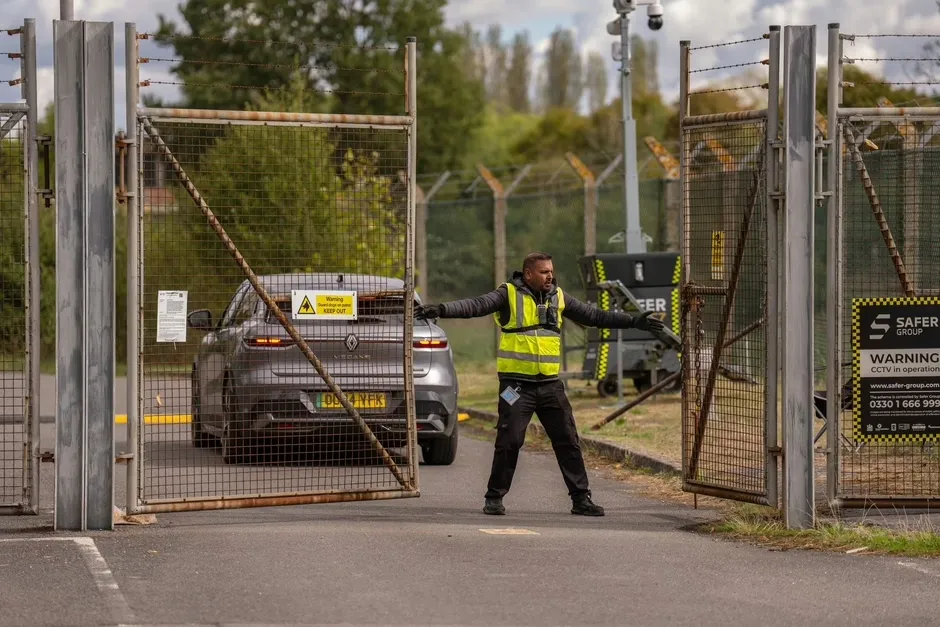
“They went on to say we are closing all asylum hotels and moving to alternative accommodation, including former military sites.
These are designed to be self-contained, with 24/7 security and CCTV to reduce the impact on local communities.”
MIGRANT PROTEST: Residents Take to the Streets Over Proposal to House More Than 1,250 Migrants Near a UK Market Town
A major immigration controversy has erupted in Britain after thousands of residents took to the streets to protest against government plans to accommodate more than 1,250 asylum seekers at a former military site near the historic market town of Bicester in Oxfordshire. The proposal has sparked anger, anxiety and political disagreements, with local residents questioning whether their community has been properly consulted before such a significant decision was considered. What began as a local protest has quickly developed into a wider national debate about immigration, housing, public services, national security and the responsibilities of the British government.
At the centre of the controversy is a former Ministry of Defence site near Bicester, close to the small village of Piddington. According to the government’s planning application, the proposed development could accommodate up to 1,256 asylum seekers. The plans include modular accommodation, healthcare and welfare facilities, security infrastructure, roads, parking areas and recreational spaces. Although the government argues that former military facilities can provide a more practical alternative to expensive asylum hotels, many residents believe that the scale of the proposal is completely disproportionate to the size of their community.
Piddington is a small rural village with approximately 350 residents. The arrival of more than 1,250 additional people could therefore transform the local population dramatically. Residents argue that the proposed accommodation would introduce a population several times larger than the village itself, creating questions about transport, healthcare, public safety and the availability of essential services.
For many people living in the surrounding area, the main concern is not simply immigration itself but the apparent lack of meaningful consultation. They believe that decisions affecting their homes and neighbourhoods should not be made without properly considering the views of those who will experience the consequences. Some residents feel that the government has placed national political priorities above the interests of local communities.
The protests have attracted considerable attention because of the determination displayed by residents. Thousands reportedly joined demonstrations in the Bicester area, carrying banners and expressing their opposition to the proposed development. Their message was clear: they wanted the government to listen to their concerns before proceeding with a project that could fundamentally change the character of the surrounding villages.
One particularly striking development was the decision by Piddington residents to organise an unofficial independence referendum. The symbolic vote attracted overwhelming support for the idea of the village becoming independent from the United Kingdom. Although the result has no legal effect, it demonstrated the strength of local frustration and attracted national and international media attention.
Residents described the unusual initiative as a way of making their voices impossible to ignore. Their argument was that a small community should have a meaningful opportunity to challenge major government decisions, particularly when those decisions could affect local life for many years.
Another important issue concerns public safety. Some residents have expressed fears about the possibility of accommodating such a large number of unfamiliar individuals close to residential areas, schools and recreational spaces. Local women have also organised campaigns calling on female Members of Parliament to take their concerns seriously.
An open letter signed by 133 women from the village highlighted worries about personal safety, freedom of movement and the future of family life in the community. The campaigners argue that residents deserve clear information about security arrangements, supervision and the procedures that would apply if problems occurred.
These concerns should be addressed through evidence, transparent planning and effective safeguards rather than assumptions about individuals based on their nationality or immigration status. Asylum seekers are not automatically criminals, and people seeking international protection should not be treated as a threat simply because they come from another country. Nevertheless, residents have a legitimate right to ask how a large accommodation facility would be managed and how local safety would be protected.
The government has defended its broader approach by arguing that Britain must move away from the expensive use of hotels to accommodate asylum seekers. Ministers say that former military facilities can offer more controlled and self-contained accommodation while reducing the financial burden on taxpayers.
The Home Office has also stated that it wants to distribute asylum accommodation more fairly across the country rather than concentrating large numbers of people in particular towns and communities. According to government statements, more than £1 billion has been saved in asylum support costs since the election. Officials have emphasised that they intend to work with local authorities and police forces to address concerns about security and the impact on surrounding areas.
However, critics argue that financial savings should not become the only consideration when choosing accommodation sites. A facility housing more than 1,250 people requires appropriate transport connections, medical services, emergency arrangements, sanitation and sufficient infrastructure. If these requirements are not properly assessed, the consequences could affect both asylum seekers and existing residents.
The economic implications are also significant. Local businesses may benefit from additional demand for certain goods and services, but residents fear that increased pressure on infrastructure could create difficulties. Questions have also been raised about the cost of converting the former military site, maintaining the accommodation and providing long-term support.
Another concern involves the potential impact on property prices. Some residents have claimed that uncertainty surrounding the proposal has affected property sales and made prospective buyers more hesitant. Whether these concerns will translate into lasting changes in property values remains uncertain, but they demonstrate how deeply the controversy has affected local confidence.
Politically, the dispute has created difficulties for the Labour government. Ministers are attempting to demonstrate that they can control immigration, reduce public spending and respond to the concerns of communities. At the same time, they must ensure that asylum seekers receive accommodation while their claims are being considered.
The government argues that the existing asylum system has been placed under considerable pressure by a large backlog of applications. Moving people out of hotels and into alternative accommodation is presented as part of a wider effort to improve efficiency and reduce costs.
However, opposition politicians have questioned whether using a relatively isolated military site is the right solution. They argue that the government must provide convincing evidence that the location is suitable and that the necessary infrastructure can be delivered without placing excessive pressure on neighbouring communities.
The controversy has also become an important issue for Reform UK and Conservative politicians, who have used the protests to challenge the government’s immigration strategy. They argue that local residents should have greater influence over decisions involving large-scale asylum accommodation and that the government must demonstrate stronger control over the country’s borders.
Nevertheless, immigration is a complex national issue that cannot be solved through slogans or political confrontation alone. Britain has legal responsibilities towards people seeking asylum, particularly individuals escaping war, persecution and serious threats to their safety. Their applications must be assessed fairly, and those who qualify for protection should receive appropriate support.
At the same time, the concerns of local communities cannot simply be dismissed. Residents should not be expected to accept major developments without proper information, consultation and guarantees concerning essential services. A fair immigration system must consider the interests of both people seeking protection and the communities expected to accommodate them.
One possible solution would be to establish a more transparent consultation process before selecting large accommodation sites. Local authorities, residents, police representatives and community organisations should have opportunities to examine proposals and raise practical concerns. Independent assessments of transport, healthcare, security and environmental impacts should also be made available.
The government should additionally consider whether large facilities are always the most effective approach. Smaller accommodation arrangements distributed across different areas could potentially reduce pressure on individual communities, although they would also require careful coordination and sufficient funding.
The role of the media is equally important. Dramatic headlines about migrant protests can attract attention, but accurate reporting must distinguish between confirmed government proposals, residents’ concerns and unverified claims. Public discussion should be based on facts rather than fear or hostility towards particular groups.
Ultimately, the Bicester and Piddington controversy represents a much wider challenge facing Britain. The country needs an asylum system that is affordable, properly managed and consistent with its legal obligations. It also needs a government that listens to local communities and recognises the practical consequences of its decisions.
In conclusion, the protests against the proposed accommodation of more than 1,250 asylum seekers near Bicester have exposed serious disagreements about immigration policy, local democracy, public spending and community responsibility. Residents believe that their concerns about the scale of the development, infrastructure and public safety deserve genuine attention, while the government maintains that alternative accommodation is necessary to reduce the costs and pressures associated with asylum hotels. Neither side can afford to ignore the legitimate challenges involved. The government must provide clear answers, conduct appropriate assessments and demonstrate that local communities will not be left to manage the consequences without sufficient support. At the same time, asylum seekers must be treated with dignity and given fair consideration under British law. The future of this proposal will be an important test of whether the government can balance national immigration responsibilities with the rights and concerns of ordinary residents. Above all, decisions of this magnitude must be made through transparency, accountability and meaningful democratic consultation rather than political confrontation.
