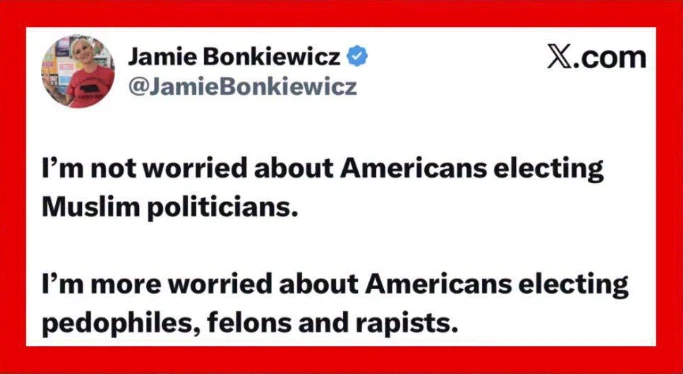
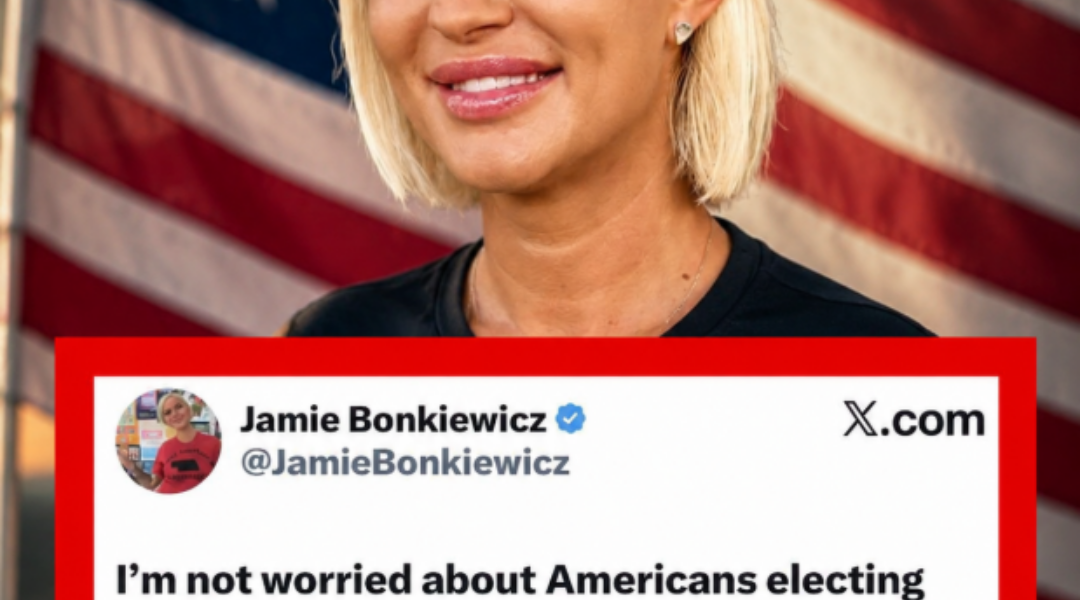
A political statement attributed to activist Jamie Bonkiewicz has drawn attention online after she wrote: “I’m not worried about Americans electing Muslim politicians. I’m more worried about Americans electing pedophiles, felons and rapists.” The short but provocative message quickly became part of a much larger debate about religion, criminal conduct, prejudice and the standards Americans should apply when choosing their elected leaders.
At its core, the statement argues that a politician’s religion should not automatically determine whether voters consider that person suitable for public office. Instead, it suggests that character, conduct and respect for the law should matter far more. The reference to Muslim politicians reflects a recurring debate in American politics, where candidates from minority religious backgrounds have sometimes faced questions and criticism centered not only on their policies but also on their faith.
The United States Constitution establishes an important principle in this discussion. Article VI states that “no religious Test shall ever be required” as a qualification for federal public office. The First Amendment also protects religious freedom and prevents the government from establishing an official religion. In practical terms, being Muslim, Christian, Jewish, Hindu, Buddhist, atheist or belonging to another faith does not legally disqualify an American from serving in Congress or other federal positions.
Yet constitutional eligibility and voter attitudes are two very different things. Religion has long played a powerful role in American elections. Candidates frequently discuss their faith, religious organizations participate in political debates, and voters sometimes consider a candidate’s beliefs when deciding whom to support. Muslim candidates, in particular, have occasionally faced suspicion tied to broader political disputes involving immigration, terrorism, foreign policy and cultural identity.
That is the environment in which Bonkiewicz’s statement carries its political message. Rather than asking voters to ignore everything about a candidate, it challenges them to distinguish between someone’s religious identity and behavior that could legitimately raise concerns about fitness for office. Her message essentially asks: why should simply being Muslim create more anxiety than serious allegations or proven misconduct involving someone seeking political power?
However, the wording also introduces an important distinction that can easily disappear when a provocative quote spreads across social media. Terms such as “pedophile,” “felon” and “rapist” do not mean the same thing legally, and accusations should not automatically be treated as convictions. A felony conviction is a specific legal outcome. Sexual offenses likewise require careful distinction between allegations, charges and convictions. Calling an identifiable person a criminal without reliable evidence can transform political rhetoric into misinformation.
That distinction is particularly important in the current social-media environment. A short statement can be screenshot, reposted and viewed millions of times while losing the context in which it was originally written. Users may interpret the same words in completely different ways. Supporters can see them as a defense of religious freedom and equal treatment. Critics may view them as a partisan attack aimed indirectly at particular political figures.
The quote does not explicitly identify any politician by name. That matters. Without additional context from the author, readers should be cautious about claiming with certainty that each label was directed at a specific individual. Social-media users may draw their own conclusions, but those conclusions are not necessarily the same as what the original post actually establishes.
The broader issue raised by the statement is nevertheless significant: what should matter most when Americans evaluate candidates for public office?
For some voters, policy remains the deciding factor. They may prioritize taxes, healthcare, immigration, abortion, education, gun laws, foreign policy or the economy. Others place greater emphasis on personal character, believing elected officials should meet a particularly high ethical standard because they are entrusted with enormous political power.
Still others argue that voters routinely apply inconsistent standards depending on whether they support the politician involved. Conduct considered disqualifying when committed by an opponent may suddenly be dismissed, minimized or rationalized when similar accusations involve someone from their own political camp. That double standard is hardly unique to one party or ideology.
Bonkiewicz’s statement challenges that tendency by framing the issue around priorities. If Americans believe personal conduct matters, the argument goes, those standards should apply consistently regardless of a candidate’s religion, race, gender or political affiliation.
The reference to Muslim politicians also touches on a deeper chapter in recent American history. Muslim Americans have increasingly entered electoral politics at local, state and federal levels. Their growing visibility has produced both support and backlash. Some voters celebrate that development as evidence that American institutions are becoming more representative of the country’s religious diversity. Others strongly disagree with the policies promoted by individual Muslim politicians—and political disagreement itself is, of course, a normal part of democracy.
The critical distinction is whether opposition is based on a politician’s policies and actions or simply on the fact that the politician is Muslim.
A voter can strongly oppose a Muslim candidate’s positions without being anti-Muslim. In the same way, supporting the right of Muslims to seek public office does not require agreeing with Muslim politicians. Religious freedom protects participation; it does not shield any elected official from criticism.
That nuance often disappears online.
Social media rewards statements that are short, emotional and easily shared. A sentence capable of generating outrage or agreement tends to travel farther than a lengthy explanation filled with qualifications. Consequently, political discussions are increasingly reduced to screenshots, memes and slogans where complicated questions become binary choices.
But the issue behind this particular statement cannot be resolved by a meme.
America has elected officials from an increasingly diverse range of religious backgrounds. Every one of those officials remains accountable for policies, decisions and personal conduct. Religious identity neither guarantees good character nor proves bad character. The same principle applies whether a candidate attends a mosque, church, synagogue, temple—or no religious institution at all.
The strongest democratic standard is therefore one that evaluates candidates according to evidence and applies the same rules consistently. Serious criminal convictions deserve scrutiny. Credible allegations deserve responsible investigation rather than automatic dismissal or automatic assumptions of guilt. Policy positions deserve debate. Religious identity, meanwhile, should not function as a substitute for evaluating any of those things.
That is ultimately why the statement has the potential to resonate beyond one viral post. Beneath its confrontational wording lies a question that reaches directly into the heart of modern American politics: What should frighten voters more—the faith a politician practices, or what that politician has actually done?
For millions of Americans increasingly frustrated by polarization and double standards, the answer may depend less on the provocative words themselves than on whether voters are willing to apply the same standard to politicians they support as they do to politicians they oppose.