WHY BRUCE LEE VS O’HARA IN ENTER THE DRAGON STILL MAKES ACTION FANS GASP AFTER FIFTY YEARS

WHEN A CALM MARTIAL ARTIST STEPS INTO AN OUTDOOR TOURNAMENT RING AGAINST A BULLYING RIVAL AND TURNS A WOODEN BOARD INTO A WARNING, YOU GET NEARLY FOUR MINUTES OF PURE ACTION CINEMA THAT MODERN MOVIES CAN ONLY ENVY.
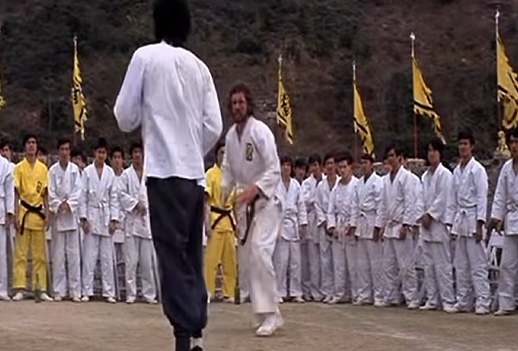
A Tense Outdoor Tournament Yard Set across a wide, sun-dappled training field surrounded by stone walls, fluttering yellow banners, and rows of seated fighters in white uniforms, this classic sequence from Enter the Dragon drips with quiet tension. Bruce Lee’s Lee stands tall in a crisp white martial arts top and dark trousers, his expression cool and unblinking as crowd chatter swirls around him. Across from him steps O’Hara, played by Robert Wall with a thick beard, dark streak across his cheek, and a white uniform marked with a bold emblem, exuding arrogant toughness. Watching from a carved dragon throne flanked by two poised attendants in purple tops, Han looks on with a cold, calculating gaze that raises the stakes of every glance. Even before a single blow lands, the visual contrast between Lee’s composed stillness and O’Hara’s snarling swagger makes the confrontation feel personal. The open yard and surrounding spectators turn a formal tournament setting into a pressure cooker waiting to blow.
A Board Snap And Cold Warning Before the physical duel breaks into full motion, the tension sharpens around a simple wooden board held steady in front of Lee. With a sudden, crisp strike, the board snaps cleanly in two as Lee holds his ground with effortless poise and a dry, cutting line telling O’Hara not to get back. The sheer economy of that moment shows Lee refusing to be rattled by intimidation or posturing in front of a crowd. Around the ring, fellow fighters watch closely while Bolo stands nearby with an imposing presence that hints at deeper danger lurking in the tournament. Every pause between glances builds suspense, letting the viewer feel the simmering hostility beneath polite tournament formality. When the standoff finally gives way to action, the release hits with extra snap because the buildup earned it.
Blistering Strikes And High Kicks Once the clash ignites in the center of the yard, Lee and O’Hara trade fast, physical blows that have spectators clapping and leaning forward. Lee weaves inside O’Hara’s reach with blinding hand speed, snapping sharp strikes that send the bearded fighter staggering and bending forward. O’Hara tries to muscle back into control with heavy swings, loud grunts, and aggressive lunges, only to get knocked off balance again and again. High, sweeping kicks whip through the air with crisp impact, dropping O’Hara onto the dirt and sending chairs and bottles scattering near the sidelines. Each exchange relies on real timing, footwork, and physical snap rather than weightless wire acrobatics or shaky-cam shortcuts. You can almost feel the thud of boots hitting turf and the sharp momentum shifting every few seconds.
Broken Glass And A Decisive Finish As the fight pushes past its opening flurry, desperation creeps into O’Hara’s eyes as he scrambles on the dirt and grabs a dark glass bottle. Smashing the bottle against the ground to fashion a jagged weapon, O’Hara lunges forward with a wild, reckless gamble to turn the tables. Lee reads the threat with razor-sharp reflexes, answering with a fast kick and a hard strike that sends the glass flying and drops O’Hara hard. A soaring leap and a ferocious final blow bring the brutal exchange to a sudden, decisive halt as O’Hara crashes onto the ground. Standing over the fallen challenger with chest heaving and eyes narrowed, Lee projects a mix of fierce resolve and cold finality. Moments later, a check of O’Hara’s pulse confirms he is gone, while Han coldly declares from his throne that O’Hara’s treachery has disgraced them.
Behind The Lens Of A Landmark Classic Released in 1973 as a defining landmark of martial arts cinema, Enter the Dragon brought crisp choreography, bold framing, and international star power together on a massive scale. Pairing Bruce Lee with Robert Wall gave the sequence a sharp physical rhythm where real falls, clear geography, and tight camera cuts sold every blow. Behind the scenes, staging high-energy kicks, flying bodies, and glass-bottle action in an open outdoor courtyard required intense precision and trust. Watching the footage today lets you appreciate how cleanly one strike flows into the next without hiding behind modern digital effects. It captures a golden era of action filmmaking when raw human athleticism and screen charisma carried the entire frame.
Why Over Seven Million Viewers Keep Rewatching With more than seven million views on this upload alone, the clip continues to draw longtime martial arts fans and curious newcomers alike. Modern action movies often bury viewers under rapid-fire editing and CGI spectacle that blur together minutes after a fight ends. Here, the action grabs you immediately because every kick, snap, and turning point feels sharp, physical, and full of character. Fans love rewatching the board break, the high kicks, the broken-bottle escalation, and the cold aftermath in the tournament yard. It stands as a vibrant reminder of why Bruce Lee’s blend of speed, edge, and screen command still thrills viewers decades later.
Do not miss your chance to experience this classic tournament showdown from its tense buildup to its dramatic finish. Hit play on the video below right now and watch Bruce Lee and O’Hara go head-to-head for yourself.