ANDY BURNHAM FACES BREXIT WARNING AS PRESSURE MOUNTS OVER CLOSER EU TIES! A POLITICAL WARNING THAT COULD CHANGE THE DEBATE! . hyn

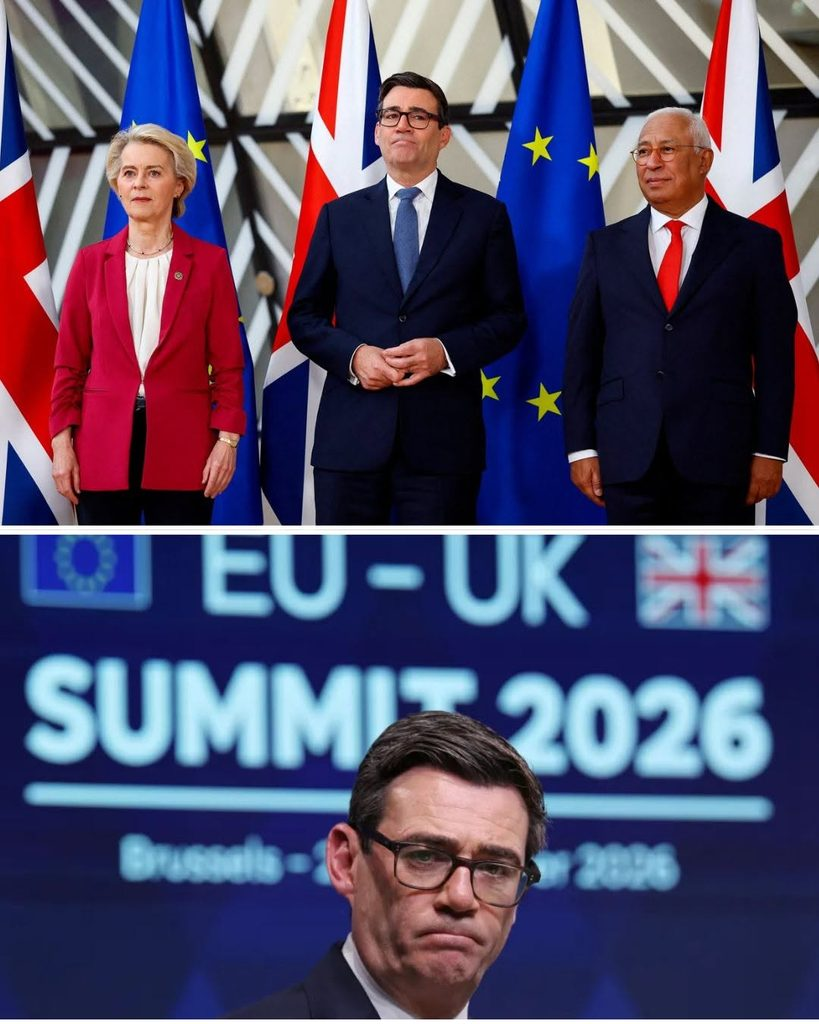
Andy Burnham has been urged to continue his push for closer EU ties – but not spend political capital on a second referendum.
Article continues below
Alan Johnson, who launched Labour’s 2016 campaign to remain in Europe, said: “Europe is still the biggest commercial market in the world — bigger than China, bigger than America.
Right on our doorstep, we would be crazy not to look for closer ties.
Particularly as the deal that Johnson did was so awful.”
But the ex-Cabinet minister cautioned against another vote on membership of the bloc, warning the Prime Minister’s time would become totally “devoted to this one single issue”.
Mr Johnson told The Mirror: “What I don’t want to see is another referendum.”
Foreign Secretary Ed Miliband on Saturday said the Government will consider the potential for the UK to rejoin the EU, saying “of course all the options will be on the table” when asked about rejoining the bloc.
“We will look at the benefits and the costs of all the different options,” he told BBC’s Laura Kuenssberg.
Referring to Mr Burnham’s comments last month that he would like to see the UK rejoin the EU in his lifetime, Mr Johnson added: “Well his lifetime is going to be longer than my lifetime because he’s a generation younger, but no time soon.
“I’m kind of in favour of closer ties, but against membership because I cannot see how you can go back into Europe without another referendum, and that it would be very damaging.”
Mr Johnson pointed to government priorities, including tackling youth unemployment in the wake of the review by Alan Milburn, and said of the prospect of another EU referendum: “Andy would be best to just leave that alone.”
The Labour grandee suggested Britain could instead push for closer security ties and look to the relationships of other European countries including Switzerland, which has access to the bloc’s single market, but are not members of the European Union.
He said: “If you were going into the single market, it wouldn’t require a referendum.
Only membership of the European Union would require [one].”
Mr Burnham reopened the debate over Brexit in his first Labour conference speech as PM in September, promising to set out options for the UK’s long-term relationship with Brussels.
He suggested it would come around the time of the UK-EU summit, but it is now expected around the time of his 10-year plan for the country, which is due before Christmas.
Friday’s summit in Brussels saw the PM agree deals with the EU on food and drink trade, carbon emissions and a reciprocal youth mobility scheme allowing 100,000 young Europeans a year to work and study in the UK.
Discussions on the level of tuition fees EU students pay will continue for another six months.
Mr Burnham also promised the EU he’s ready to “brainstorm” ideas for closer ties over the next year.
The PM has vowed to stick to Labour’s 2024 manifesto red lines on not rejoining the EU, single market, or customs union, before the next general election.
But he has left the door open to how the UK pushes for closer ties in Labour’s next election blueprint document.
It has led to a series of pro-rejoin interventions from a string of Starmer-era Cabinet ministers including former Chancellor Rachel Reeves, ex-Deputy PM David Lammy, and former Business Secretary Peter Kyle.
Earlier this week, Mr Lammy, who was also Foreign Secretary, said Labour should go into the next general election “clear that its intention is to rejoin the EU” in its manifesto.
Mr Lammy said once a new deal is agreed with the bloc after post-election negotiations, it should be put to voters in a second referendum on EU membership.
Writing for the Sunday Mirror, Emily Thornberry, chair of the Commons’ foreign affairs committee, said she believes Britain “should simply be back in the European Union”.
“Personally, I think Labour should just be bold, set out exactly what sort of re-entry deal it would seek to secure for the country, slap it on our next manifesto, and let the voters make the final call,” she said.
Mr Johnson, the former chair of Labour’s referendum Remain campaign, praised the Prime Minister’s “brave” conference speech to the party faithful.
He said: “It was actually saying ‘here’s things we could never talk about, but we should talk about, and we should discuss.’
So let’s have the discussion, let’s have the conversation. My position is closer ties, but forget about rejoining.”
The former Home Secretary added: “I’m very much in favour of closer ties with Europe.
But I can’t see how you could put membership of the European Union forward without having another referendum.
“So apart from all the problems you’ve got, could we still stay out of the single currency?
Could we still stay out of Schengen? We lost all those advantages that were negotiated when we were in.
Well, they’re all gone now.
“And you start mixing those in and you might see that quite soft lead in terms of people saying we should be members of the European Union again— you’ll see that vanish.
“Worst of all, you’re going to use time and energy and political capital which we should be using to get kids back you know, on the Milburn report and on all the other things.
It would totally be devoted to this one single issue.”
The ex-Labour minister also dismissed a recent intervention from failed ex-Tory PM Boris Johnson, who accused Mr Burnham of betraying voters on the issue of Brexit.
But he said: “It’s typical Boris Johnson.
He messed this up completely.
I mean, you go to people in Northern Ireland where he was promising no border in the Irish Sea — you know, Johnson was completely out of his depth.”
Mr Johnson added: “He’s trying to justify a terrible deal.
I think we’re well beyond thinking that Boris Johnson’s got any wisdom in this area.”
Andy Burnham Faces Brexit Warning as Pressure Mounts Over Closer EU Ties: A Political Warning That Could Change the Debate
Britain’s political debate over Brexit has entered another controversial phase as Andy Burnham faces increasing scrutiny over discussions about rebuilding relations with the European Union. The possibility of closer economic and political cooperation with Brussels has generated strong reactions from supporters of Brexit, who remain concerned that the country could gradually move towards reversing its decision to leave the EU. The debate has once again placed national sovereignty, immigration, trade, economic growth and democratic accountability at the centre of British politics.
The warning comes against a background of continuing disagreements about the long-term consequences of Brexit. Although the United Kingdom officially left the European Union in January 2020, its relationship with European countries remains an important political and economic issue. Businesses, politicians and ordinary citizens continue to debate whether the current arrangements provide sufficient opportunities for economic development or whether closer cooperation would produce greater benefits.
Andy Burnham has attracted attention because of his political influence and his involvement in discussions about Britain’s economic future. Supporters of closer European ties argue that rebuilding relationships with the EU could help British businesses, improve trade and encourage investment. They believe that cooperation with European partners is particularly important at a time when the global economy is becoming increasingly competitive. However, critics warn that any movement towards closer integration must be examined carefully to ensure that Britain does not gradually surrender the independence it gained through Brexit.
One of the strongest arguments made by Brexit supporters concerns national sovereignty. They believe that leaving the European Union was a historic opportunity for Britain to regain control over its laws, borders and economic policies. In their view, decisions affecting British citizens should be made by elected representatives in Westminster rather than being influenced by institutions based in Brussels. They also argue that the 2016 referendum represented a clear democratic instruction that politicians should respect.
The referendum remains a defining moment in modern British history. Approximately 17.4 million people voted to leave the European Union, compared with around 16.1 million who voted to remain. For many Leave supporters, the result represented a demand for political independence and greater control over national affairs. Consequently, any proposal that appears to move Britain towards European integration can generate strong opposition among voters who believe that the referendum result must be respected.
However, supporters of closer EU ties argue that cooperation does not necessarily mean abandoning Brexit. There are different ways for countries to develop economic partnerships without becoming members of the same political organisation. Britain could potentially negotiate arrangements concerning trade, research, energy, security and professional qualifications while remaining outside the European Union. From this perspective, the debate should focus on practical economic benefits rather than treating every form of cooperation as an attempt to reverse Brexit.
Trade is one of the most important issues in this discussion. The European Union remains a major trading partner for the United Kingdom, and British companies depend on access to European customers, suppliers and markets. Since Brexit, businesses have had to adapt to new customs procedures, regulatory requirements and administrative arrangements. Smaller companies may find these additional responsibilities particularly difficult because they often have fewer resources to manage international paperwork.
Supporters of closer cooperation argue that reducing unnecessary barriers could help British businesses become more competitive. Improved arrangements might make it easier for exporters, manufacturers and service providers to operate across European markets. They also believe that closer cooperation could encourage international investment and strengthen Britain’s position in important industries such as technology, renewable energy, pharmaceuticals and advanced manufacturing.
Nevertheless, Brexit supporters argue that Britain should not sacrifice its regulatory independence simply to make trade easier. They believe that the country should use its freedom to negotiate agreements with countries around the world and develop policies that reflect domestic economic priorities. They also argue that the benefits of independent decision-making may become more visible over time as Britain develops new international partnerships.
Immigration is another sensitive issue that could influence the debate. One of the central arguments behind the Leave campaign was the desire to regain control over immigration policy. Many voters believed that leaving the EU would allow the government to establish a system based more directly on national priorities. Today, immigration continues to generate public discussion, particularly regarding small-boat crossings, asylum applications and pressure on housing and public services.
Critics of closer European integration fear that certain arrangements could eventually increase migration or limit the government’s ability to introduce independent border policies. They argue that immigration rules must remain under British control and that public confidence depends on the effective enforcement of those rules.
On the other hand, international cooperation can also help governments manage migration more effectively. Britain and European countries share interests in combating human trafficking, organised crime and dangerous smuggling networks. Working together on border security and intelligence could provide practical advantages without necessarily requiring Britain to rejoin the EU. Therefore, immigration policy should be examined separately from wider economic cooperation.
Another important consideration is the future of Britain’s younger generations. Students, graduates and young professionals may benefit from opportunities to study, work and participate in research programmes across Europe. Greater cooperation could potentially make international exchanges easier and provide access to educational and professional opportunities. However, the precise benefits would depend on the agreements negotiated by the British government.
The political consequences of the debate are also significant. Brexit remains an important dividing line between different political parties and sections of the electorate. Some politicians believe that the country should focus on implementing Brexit and avoiding renewed arguments about membership of the European Union. Others argue that refusing to reconsider existing arrangements could prevent Britain from responding effectively to changing economic circumstances.
Nigel Farage and other prominent Brexit supporters have consistently emphasised the importance of respecting the referendum result. They warn that attempts to move towards closer European integration could undermine public trust in politicians. Their position reflects concerns that voters who supported Brexit may feel ignored if major changes are introduced without sufficient public consultation.
Nevertheless, democratic accountability also requires politicians to examine whether existing policies are achieving their intended objectives. Governments must be able to review international agreements, consider economic evidence and discuss alternative arrangements. The important question is how such decisions should be made and whether the public should have a direct opportunity to express its views on fundamental changes.
The media also plays an important role in shaping public understanding of these developments. Dramatic headlines about political warnings and explosive Brexit disagreements can attract attention, but they do not always explain the practical differences between trade cooperation, single-market participation, customs arrangements and full EU membership. These are distinct political and economic arrangements, each involving different rights, responsibilities and potential consequences.
For this reason, voters should examine the details of any proposal rather than relying entirely on political slogans. Politicians should explain what closer relations would involve, whether additional financial contributions would be required, what regulatory responsibilities might change and how the arrangements would affect British businesses and households.
Ultimately, the debate surrounding Andy Burnham and closer European ties reflects a much wider question about Britain’s identity and future direction. The country must decide how to balance political independence with international cooperation in an increasingly interconnected world. Maintaining sovereignty is important, but so is developing productive relationships with neighbouring countries and global trading partners.
In conclusion, Andy Burnham’s position in the debate over closer EU relations has brought renewed attention to the unresolved political consequences of Brexit. Supporters of greater cooperation believe that stronger European relationships could create economic opportunities, while Brexit supporters remain concerned about national sovereignty and the democratic mandate of the 2016 referendum. Both perspectives raise important questions that deserve serious consideration. Britain’s future should be determined through transparent negotiations, reliable economic evidence and meaningful democratic participation. Rather than allowing political warnings and dramatic headlines to dominate the discussion, the government should provide clear information about the available options and their long-term consequences. Only through informed debate can Britain develop a relationship with Europe that reflects its national interests while respecting the democratic choices of its people.