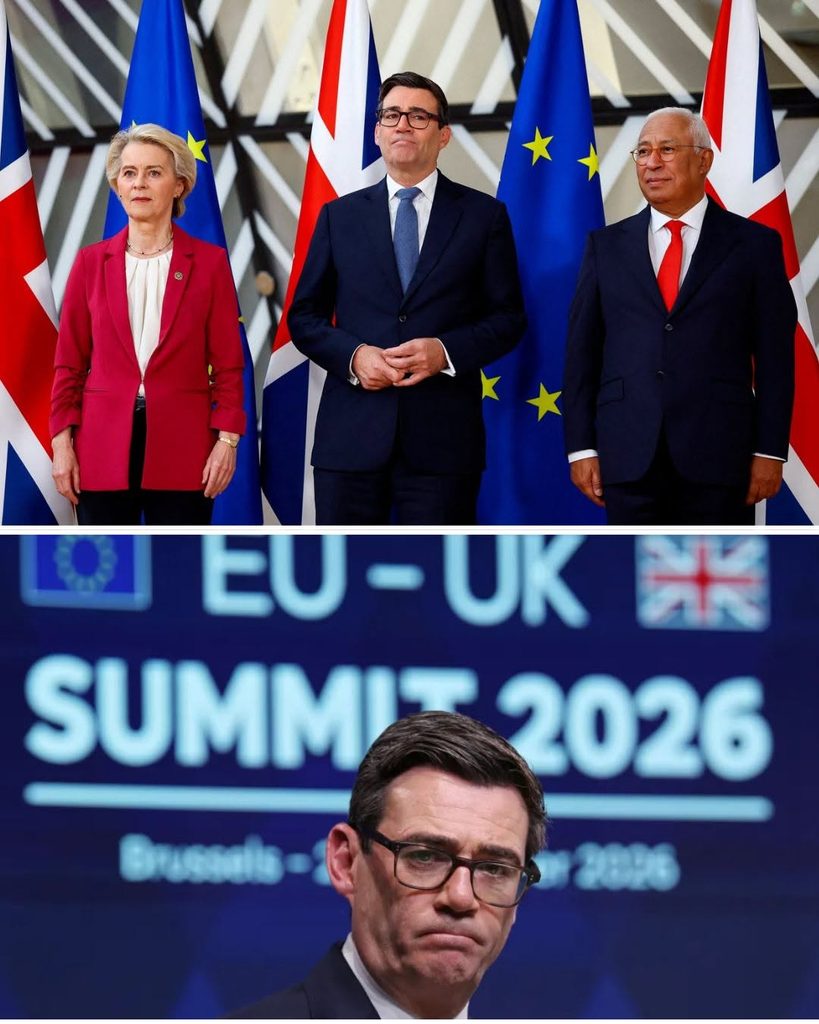
Andy Burnham has been urged to continue his push for closer EU ties – but not spend political capital on a second referendum.
Article continues below
Alan Johnson, who launched Labour’s 2016 campaign to remain in Europe, said: “Europe is still the biggest commercial market in the world — bigger than China, bigger than America. Right on our doorstep, we would be crazy not to look for closer ties. Particularly as the deal that Johnson did was so awful.”
Article continues below
But the ex-Cabinet minister cautioned against another vote on membership of the bloc, warning the Prime Minister’s time would become totally “devoted to this one single issue”. Mr Johnson told The Mirror: “What I don’t want to see is another referendum.”
Foreign Secretary Ed Miliband on Saturday said the Government will consider the potential for the UK to rejoin the EU, saying “of course all the options will be on the table” when asked about rejoining the bloc.
“We will look at the benefits and the costs of all the different options,” he told BBC’s Laura Kuenssberg.
Referring to Mr Burnham’s comments last month that he would like to see the UK rejoin the EU in his lifetime, Mr Johnson added: “Well his lifetime is going to be longer than my lifetime because he’s a generation younger, but no time soon.
“I’m kind of in favour of closer ties, but against membership because I cannot see how you can go back into Europe without another referendum, and that it would be very damaging.”
Mr Johnson pointed to government priorities, including tackling youth unemployment in the wake of the review by Alan Milburn, and said of the prospect of another EU referendum: “Andy would be best to just leave that alone.”
The Labour grandee suggested Britain could instead push for closer security ties and look to the relationships of other European countries including Switzerland, which has access to the bloc’s single market, but are not members of the European Union.
He said: “If you were going into the single market, it wouldn’t require a referendum. Only membership of the European Union would require [one].”
Mr Burnham reopened the debate over Brexit in his first Labour conference speech as PM in September, promising to set out options for the UK’s long-term relationship with Brussels. He suggested it would come around the time of the UK-EU summit, but it is now expected around the time of his 10-year plan for the country, which is due before Christmas.
Friday’s summit in Brussels saw the PM agree deals with the EU on food and drink trade, carbon emissions and a reciprocal youth mobility scheme allowing 100,000 young Europeans a year to work and study in the UK. Discussions on the level of tuition fees EU students pay will continue for another six months.
Mr Burnham also promised the EU he’s ready to “brainstorm” ideas for closer ties over the next year.
The PM has vowed to stick to Labour’s 2024 manifesto red lines on not rejoining the EU, single market, or customs union, before the next general election. But he has left the door open to how the UK pushes for closer ties in Labour’s next election blueprint document.
It has led to a series of pro-rejoin interventions from a string of Starmer-era Cabinet ministers including former Chancellor Rachel Reeves, ex-Deputy PM David Lammy, and former Business Secretary Peter Kyle.
Earlier this week, Mr Lammy, who was also Foreign Secretary, said Labour should go into the next general election “clear that its intention is to rejoin the EU” in its manifesto. Mr Lammy said once a new deal is agreed with the bloc after post-election negotiations, it should be put to voters in a second referendum on EU membership.
Writing for the Sunday Mirror, Emily Thornberry, chair of the Commons’ foreign affairs committee, said she believes Britain “should simply be back in the European Union”.
“Personally, I think Labour should just be bold, set out exactly what sort of re-entry deal it would seek to secure for the country, slap it on our next manifesto, and let the voters make the final call,” she said.
Mr Johnson, the former chair of Labour’s referendum Remain campaign, praised the Prime Minister’s “brave” conference speech to the party faithful. He said: “It was actually saying ‘here’s things we could never talk about, but we should talk about, and we should discuss.’ So let’s have the discussion, let’s have the conversation. My position is closer ties, but forget about rejoining.”
The former Home Secretary added: “I’m very much in favour of closer ties with Europe. But I can’t see how you could put membership of the European Union forward without having another referendum.
“So apart from all the problems you’ve got, could we still stay out of the single currency?
Could we still stay out of Schengen? We lost all those advantages that were negotiated when we were in. Well, they’re all gone now.
“And you start mixing those in and you might see that quite soft lead in terms of people saying we should be members of the European Union again— you’ll see that vanish.
“Worst of all, you’re going to use time and energy and political capital which we should be using to get kids back you know, on the Milburn report and on all the other things. It would totally be devoted to this one single issue.”
The ex-Labour minister also dismissed a recent intervention from failed ex-Tory PM Boris Johnson, who accused Mr Burnham of betraying voters on the issue of Brexit.
But he said: “It’s typical Boris Johnson.
He messed this up completely. I mean, you go to people in Northern Ireland where he was promising no border in the Irish Sea — you know, Johnson was completely out of his depth.”
Mr Johnson added: “He’s trying to justify a terrible deal. I think we’re well beyond thinking that Boris Johnson’s got any wisdom in this area.”
BREXIT WAR ERUPTS! Nigel Farage Vows to Take on Andy Burnham in What He Calls a “Brexit Election”
Britain’s political landscape is facing renewed tensions as Nigel Farage declares that he is ready to challenge Andy Burnham in what he describes as a potential “Brexit election”. The Reform UK leader has made it clear that he intends to bring Britain’s relationship with the European Union back to the centre of national politics. His announcement follows growing controversy over Prime Minister Andy Burnham’s plans to reconsider Britain’s long-term relationship with Europe and explore opportunities for closer cooperation with Brussels.
The dispute represents a significant development in the continuing debate over Brexit. Although Britain officially left the European Union in 2020, disagreements about the consequences of that decision have never completely disappeared. Questions about trade, immigration, national sovereignty and economic growth continue to divide politicians and voters. Farage’s latest intervention suggests that Brexit could once again become a defining issue in the next general election.
Speaking in Brussels, Farage accused Burnham of reopening political arguments that he believes should have been settled by the 2016 referendum. He suggested that the Prime Minister’s approach to closer European relations could lead to a new national election dominated by the question of Britain’s future relationship with the EU. Farage also indicated that he was prepared to return to the political battlefield after spending decades campaigning for British independence from European institutions.
His message was unmistakable: he believes that voters should be given the opportunity to decide whether Britain continues along its current path or moves towards closer European integration. Farage has portrayed the potential election as a major political confrontation over the country’s future direction. His position reflects the continuing importance of Brexit among Reform UK supporters and other voters who believe that the referendum result must be respected.
At the centre of the controversy is Andy Burnham’s proposal to reopen a national conversation about Britain’s relationship with Europe. The Prime Minister has discussed several possible arrangements, including maintaining the existing relationship, pursuing closer cooperation or considering different forms of economic integration. These options have generated debate because they could have different consequences for British businesses, workers, consumers and national institutions.
Supporters of Burnham’s approach argue that Britain should be willing to reconsider its economic relationships when circumstances change. They point out that the European Union remains one of the country’s most important trading partners. Improving cooperation could reduce unnecessary barriers, support British exporters and create opportunities for investment. They also argue that international collaboration is increasingly important in areas such as scientific research, technology, energy and security.
However, Farage and other Brexit supporters strongly disagree with the idea of moving towards greater European integration. They argue that leaving the EU was about restoring Britain’s ability to make independent decisions. In their view, closer alignment with European institutions could gradually reduce the political independence that voters supported in 2016. They believe that Britain should concentrate on developing its own economic policies and negotiating trade agreements with countries across the world.
One of the most important issues in this disagreement is national sovereignty. For many Brexit supporters, sovereignty means that the British Parliament should have the final authority over domestic laws and regulations. They believe that important decisions concerning immigration, employment, agriculture, trade and public services should be made by British representatives who are directly accountable to voters.
On the other hand, supporters of closer European cooperation argue that independence does not require isolation. Britain can retain its national institutions while working with European partners on shared economic and international challenges. They believe that cooperation can produce practical advantages without necessarily requiring the country to become an EU member again.
Trade is another major source of disagreement. Since leaving the European Union, British businesses have had to adapt to new customs procedures and regulatory requirements when trading with European countries. Some companies have reported additional administrative costs and difficulties, particularly smaller businesses that lack the resources of larger international corporations.
Supporters of closer relations believe that reducing these barriers could improve the competitiveness of British businesses. Better access to European markets could benefit manufacturers, farmers, exporters and service providers. They also argue that closer economic cooperation could encourage foreign investment and support employment.
Nevertheless, Brexit supporters maintain that Britain should use its independence to develop new opportunities. They argue that the country has considerable strengths in financial services, artificial intelligence, scientific research and advanced technology. According to this perspective, Britain should avoid becoming too closely tied to European regulations and instead develop policies that encourage innovation and international competition.
Immigration is equally important in the developing political confrontation. One of the main arguments behind the Leave campaign was the desire to regain control over immigration policy. Many voters believed that Brexit would allow the government to establish a system based entirely on British priorities. Today, immigration remains a sensitive issue, particularly in relation to irregular Channel crossings, asylum applications and pressure on public services.
Farage’s supporters argue that closer European integration could eventually weaken Britain’s ability to control immigration independently. They believe that the government must demonstrate that it can manage its borders effectively and maintain public confidence in the immigration system.
However, immigration also brings economic benefits. International workers contribute to healthcare, construction, agriculture, hospitality and other important industries. Furthermore, cooperation between Britain and European countries can help combat organised crime, human trafficking and dangerous smuggling networks. Therefore, any future immigration arrangements must balance border security with economic requirements and humanitarian responsibilities.
The political implications of the dispute could extend beyond the two main figures involved. Other political parties may also be forced to clarify their positions on Brexit and European integration. The Conservative Party, Reform UK and Labour could face difficult questions from voters about whether Britain should maintain its current arrangements or pursue closer relations with Brussels.
For voters, the central question is not simply whether they supported Leave or Remain in 2016. It is whether Britain’s current relationship with Europe is delivering the economic and political outcomes they expected. Some citizens remain strongly committed to Brexit, while others believe that closer cooperation is necessary to address problems that have emerged since departure.
Farage’s declaration that he is ready for another political battle demonstrates how Brexit continues to influence the national conversation. His proposed “Brexit election” framing seeks to make Britain’s relationship with Europe a central electoral question. However, whether the next general election will ultimately be dominated by this issue remains uncertain. Other matters, including the cost of living, housing, healthcare, employment and national security, are also likely to feature prominently in political discussions.
The media will undoubtedly play an important role in shaping public understanding of the confrontation. Political slogans and dramatic statements can attract attention, but voters need detailed information about the actual policies being proposed. There is an important difference between rejoining the European Union, joining the single market, participating in the customs union and negotiating individual cooperation agreements. Each arrangement involves different obligations and potential benefits.
Ultimately, the debate should focus on evidence rather than political confrontation. Both sides should explain how their proposals would affect the economy, immigration, public services and Britain’s international position. Citizens deserve clear answers about the costs, advantages and possible disadvantages of every available option.
In conclusion, Nigel Farage’s declaration that he is prepared to challenge Andy Burnham in a potential “Brexit election” has brought Britain’s relationship with Europe back into the political spotlight. The disagreement reflects deeper questions about national sovereignty, economic opportunity, immigration and democratic accountability. While Farage believes that closer European integration risks undermining the achievements of Brexit, supporters of Burnham’s approach argue that stronger cooperation could benefit Britain’s future. The next stage of this debate will depend on the policies presented by political leaders and the response of the electorate. Whatever direction Britain eventually chooses, its future relationship with Europe should be determined through informed democratic discussion, transparent decision-making and respect for the different views of its citizens.