A Man Threatened to Kill an ICE Officer and His Entire Family on Camera. Now He Faces Federal Charges..916

A protest outside a federal immigration detention facility crossed a dangerous legal line when a man allegedly threatened to kill a federal immigration officer and the officer’s entire family. The disturbing statements were captured on video, spread across social media, and quickly drew the attention of federal authorities. Not long afterward, the FBI identified and arrested 27-year-old Nicholas Matthew Scelfo of Brooklyn, New York, charging him with threatening a federal law enforcement officer.
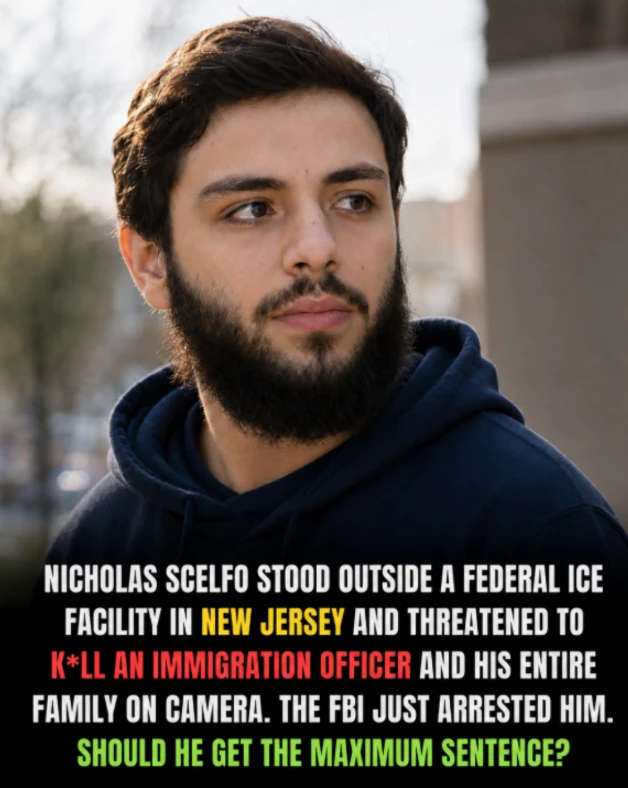
According to the U.S. Department of Justice, the incident took place on May 27, 2026, during a protest outside an Immigration and Customs Enforcement (ICE) detention facility. Peaceful demonstrations and political protests are protected under the First Amendment, allowing citizens to express opposition to government policies. However, prosecutors allege that Scelfo’s conduct went far beyond protected political speech when he directed explicit threats of violence toward an ICE officer who was performing official duties.
Federal authorities say video footage posted online captured Scelfo shouting that he would kill the ICE officer’s entire family, specifically mentioning the officer’s wife and children. Investigators allege he also claimed to have memorized the officer’s face and repeatedly threatened that the officer would die. Those statements, quoted in the federal criminal complaint, became central evidence in the government’s case.
What makes the allegations especially serious is that the threats were not directed solely at a federal employee but also at innocent family members who had no involvement in law enforcement. Spouses and children of public servants are not responsible for government policy or official decisions, yet threats against them can create lasting fear and place tremendous emotional pressure on those serving in dangerous public positions.

After the video circulated online, federal investigators began working to identify the individual responsible. Agents with the FBI offices in Newark and New York reviewed video footage, gathered witness statements, and collected additional evidence. Scelfo was eventually arrested and appeared before a federal magistrate judge. Prosecutors allege that he knowingly threatened to assault and murder a federal officer with the intent to intimidate, interfere with, or retaliate against that officer while performing official duties.
It is important to note that Scelfo has been charged, not convicted. Under the American justice system, every defendant is presumed innocent unless proven guilty beyond a reasonable doubt. The court will ultimately determine whether prosecutors have established that his statements constituted a legally actionable “true threat” under federal law.
The case also highlights the important distinction between protected speech and criminal conduct. Americans have every right to criticize ICE, protest immigration policies, demand reform, or advocate for the abolition of a government agency. The Constitution protects passionate—even harsh—political speech. However, federal law does not protect specific threats of violence directed at identifiable individuals. When someone allegedly threatens to kill a federal officer and that officer’s family, the issue shifts from political expression to potential criminal conduct.
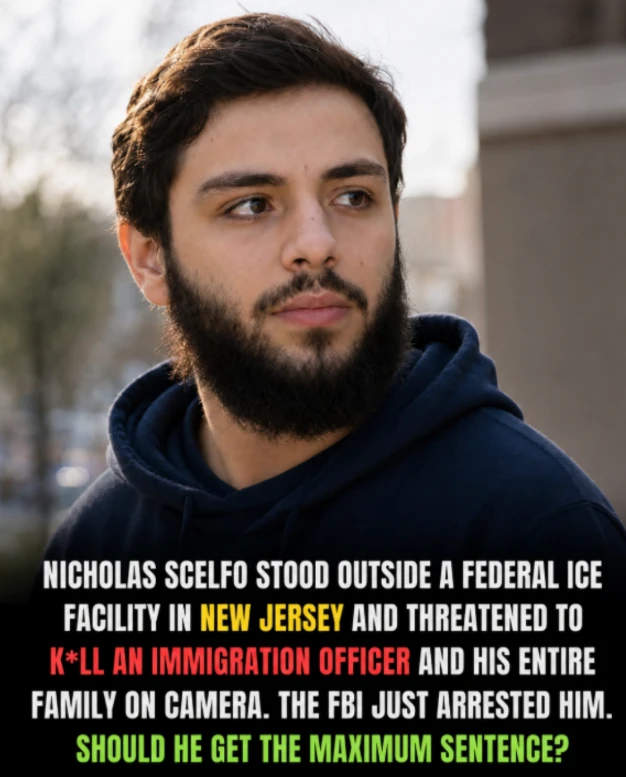
According to federal prosecutors, if convicted, Scelfo could face up to 10 years in federal prison and a fine of up to $250,000. The actual sentence, if there is a conviction, would be determined by a federal judge after considering sentencing guidelines, the defendant’s criminal history, the seriousness of the offense, and any mitigating or aggravating circumstances.
The case unfolds amid continuing national debate over immigration enforcement. ICE remains one of the most controversial federal agencies in the United States. Supporters argue that the agency plays a vital role in enforcing immigration laws, executing deportation orders, and protecting public safety. Critics contend that some enforcement practices are overly aggressive and have caused hardship for immigrant communities.
Regardless of political views, federal officials argue that threats of violence against law enforcement officers cannot be tolerated. Public debate over immigration policy may be intense, but prosecutors maintain that threatening to kill officers or their families crosses a legal boundary that warrants federal prosecution.
At the same time, it is important not to generalize the actions of one individual to every protester or activist. The overwhelming majority of demonstrations across the country remain peaceful, with participants exercising their constitutional rights responsibly. Criminal responsibility belongs only to the individual accused of making unlawful threats—not to an entire movement or political viewpoint.
The case also serves as a reminder of the risks faced by law enforcement officers and their families. Officers knowingly accept the dangers associated with their profession, but their spouses and children should never become targets of intimidation or retaliation. Public threats can have lasting psychological effects and, in some cases, may encourage others to engage in harassment or violence.
Federal authorities say the FBI’s swift investigation demonstrates that threats against federal employees will be taken seriously. While not every angry remark results in criminal charges, prosecutors argue that explicit, targeted threats intended to intimidate or retaliate against a federal officer require immediate attention.
The final outcome of the case now rests with the federal court system. If prosecutors prove that Scelfo intentionally threatened an ICE officer and the officer’s family in violation of federal law, the court may impose a significant sentence designed to protect public officials and deter similar conduct in the future. Any punishment, however, must be based on evidence presented in court—not on public opinion or social media reaction.
Ultimately, this case underscores a clear legal principle. Americans have the right to protest government policies, criticize ICE, and advocate for change. But when someone allegedly stands in front of a camera and threatens to kill a federal officer and that officer’s family, the matter is no longer simply political—it becomes a criminal case. The federal courts will now decide whether the evidence supports those charges and what consequences, if any, should follow.