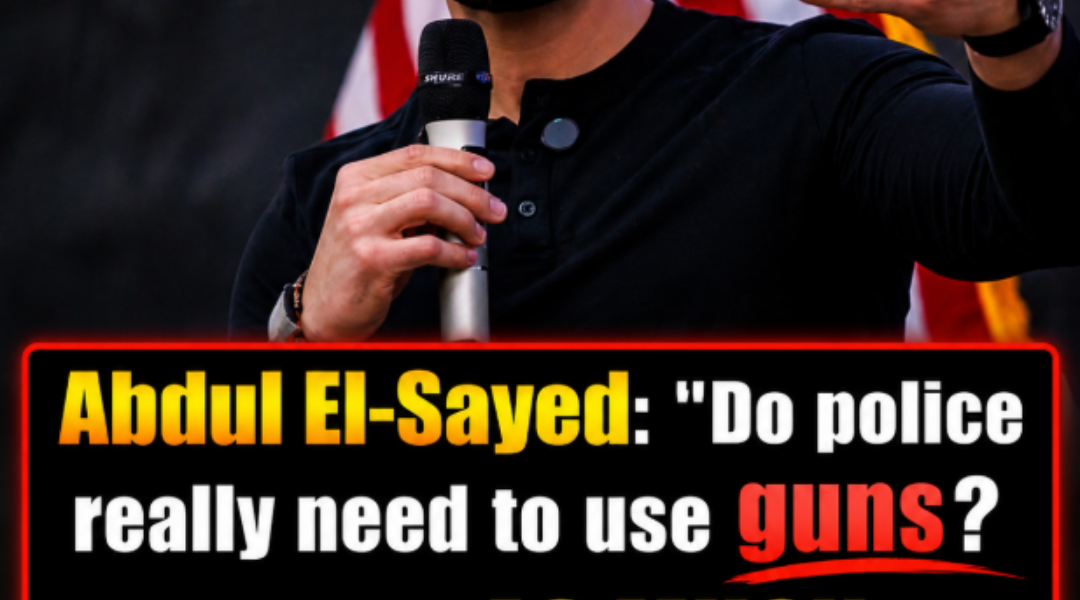
Abdul El-Sayed’s Past Police Comments Resurface as Michigan Senate Race Intensifies.917

Abdul El-Sayed, a Michigan Democrat and former gubernatorial candidate, is facing renewed scrutiny after an old video resurfaced showing him questioning the size, equipment, and role of American police departments. In the recording, El-Sayed asked, “Do police really need to use guns? Do we need as much of a police force?” The comments have quickly spread across social media, with critics portraying them as evidence that he once supported the most radical elements of the “defund the police” movement. Supporters, however, argue that the clip is being separated from a broader discussion about poverty, public health, military equipment, and how governments choose to spend taxpayer money.

The original comments were made during the national debate over policing and racial inequality that followed the killing of George Floyd in 2020. During a University of Michigan discussion about systemic racism as a public-health issue, El-Sayed questioned whether police departments needed military-style equipment, including tanks and weapons transferred from the armed forces. He then asked whether officers always needed to use guns and whether communities required police forces of their existing size. His broader argument was that governments should invest more heavily in addressing poverty rather than spending so much money “policing poverty.”
That context has become central to the current controversy. El-Sayed’s defenders say he was not proposing that every officer immediately surrender a firearm or that police departments disappear overnight. Instead, they say he was challenging the assumption that armed police should be the default response to every social problem. From this perspective, mental-health crises, homelessness, addiction, school discipline, and certain nonviolent calls might sometimes be handled more effectively by trained medical professionals, social workers, or community response teams.
Critics interpret his words very differently. They argue that asking whether police need guns ignores the dangerous situations officers routinely encounter, including armed robberies, domestic violence, shootings, and confrontations with suspects carrying weapons. They also contend that questioning whether society needs “as much of a police force” sounds less like limited reform and more like a proposal to reduce the number of officers available to protect communities.
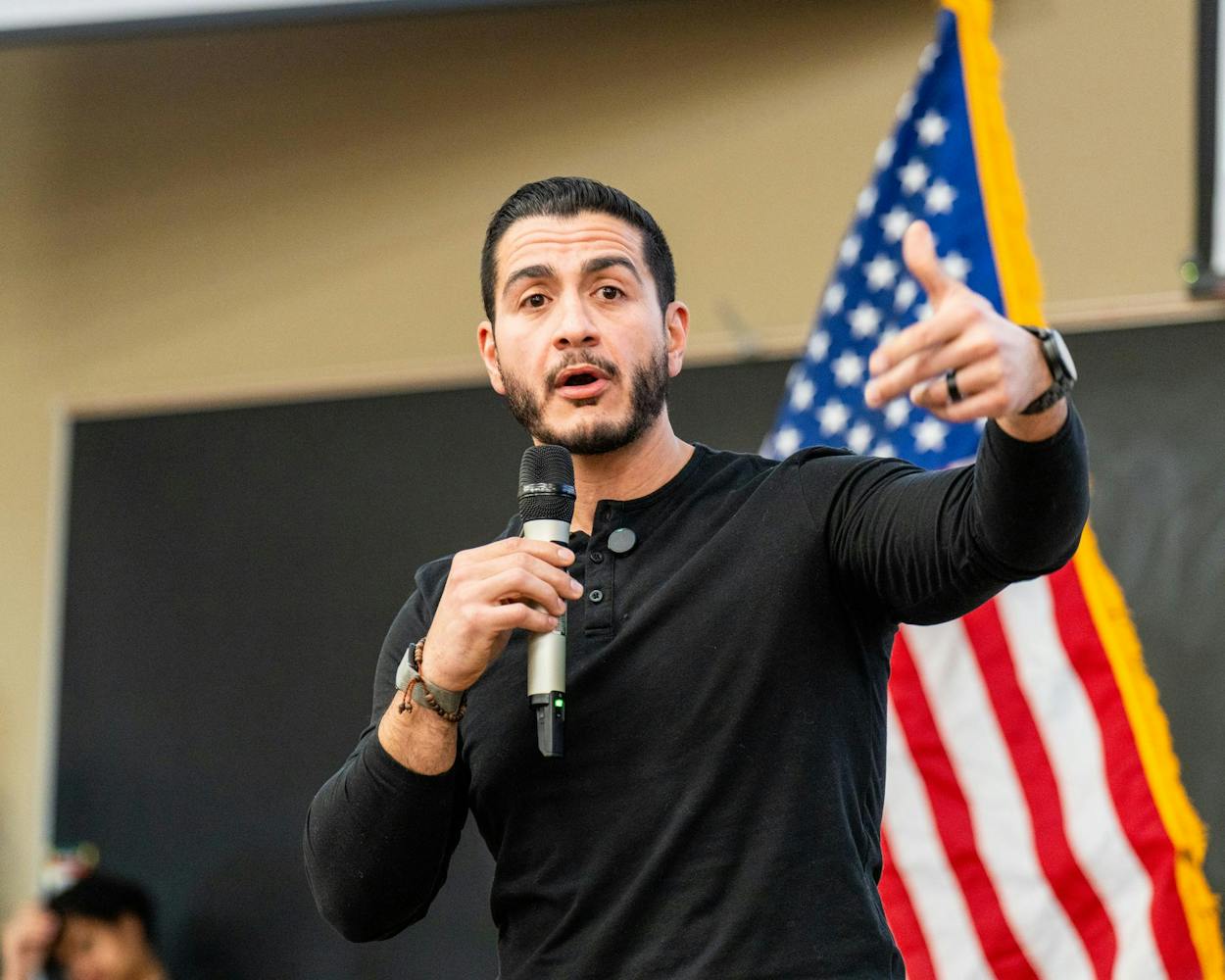
The resurfaced video is especially significant because El-Sayed is currently competing in Michigan’s high-profile Democratic primary for the U.S. Senate seat being vacated by retiring Sen. Gary Peters. The August 4, 2026, primary has become an ideological battle between El-Sayed’s progressive campaign and the more establishment-oriented candidacy of Rep. Haley Stevens. The result could influence not only control of a closely divided Senate but also the direction of the Democratic Party in a crucial battleground state.
El-Sayed is a physician, epidemiologist, and former Detroit health director who has built his political identity around Medicare for All, economic inequality, public investment, and progressive reform. He previously ran for governor of Michigan in 2018 but lost the Democratic primary. He returned to electoral politics by launching his Senate campaign in 2025 and has since gained support from major progressive figures, including Sen. Bernie Sanders and Rep. Alexandria Ocasio-Cortez.
His policing comments have therefore become more than a dispute over an old video. They are now being used to define what kind of candidate he is and whether his past positions would make him vulnerable in a general election. Republicans and moderate Democrats have repeatedly warned that the “defund the police” slogan damaged the Democratic Party, particularly among suburban voters, working-class communities, and people worried about public safety.
The phrase itself has always carried different meanings. For some activists, “defund the police” meant reducing police budgets and shifting part of that money toward housing, healthcare, schools, violence-prevention programs, and mental-health services. For others, it meant dramatically shrinking or eventually replacing traditional police departments. Because the slogan could represent anything from budget reform to complete abolition, politicians who used or appeared to support it often faced questions about exactly what they intended.
In a 2020 interview about policing and public health, El-Sayed argued that more money should be directed toward social services. His position was rooted in the belief that poverty, poor health, unemployment, and lack of opportunity often contribute to crime and repeated interactions with law enforcement. Rather than waiting until those problems produce an emergency, he argued, government should invest earlier in the conditions that make communities safer.
Yet the resurfaced material suggests that his language at the time went further than merely supporting additional social programs. Another 2020 statement attributed to El-Sayed included his saying that police should be defunded to the extent that government should reduce investment in systems that incarcerate or kill people and redirect that funding toward education and community empowerment. That record has allowed opponents to argue that his current effort to distance himself from the unpopular slogan is inconsistent with what he previously said.
El-Sayed has responded by emphasizing the substance behind his position rather than the slogan itself. He has argued that political coverage too often focuses on the phrase “defund the police” while ignoring the question of how communities can prevent crime before it happens. His central message is that public safety should not be measured only by the number of officers, guns, arrests, or prisons. It should also be measured by whether families have stable housing, young people have educational opportunities, patients can obtain mental-health treatment, and communities have resources that reduce desperation and violence.
That argument resonates with many progressive voters, particularly those who believe American policing has been asked to perform too many functions. Police officers are often sent to respond to mental-health emergencies, homelessness, substance abuse, school conflicts, traffic incidents, welfare checks, and neighborhood disputes. Reform advocates say that creating specialized alternatives could reduce unnecessary confrontations and allow officers to concentrate on serious and violent crime.
Law-enforcement supporters counter that even apparently routine calls can become dangerous with little warning. A welfare check may uncover domestic abuse. A traffic stop may involve an armed suspect. A mental-health crisis may include a weapon or an immediate threat to others. From their perspective, removing firearms from officers or significantly reducing police staffing could leave both first responders and civilians exposed.
The debate is also complicated by the fact that public safety concerns vary greatly from one community to another. Residents of neighborhoods suffering from gun violence may simultaneously demand police accountability and stronger protection from violent offenders. Many do not see those goals as contradictory. They may support better training, greater transparency, limits on unnecessary force, and social investment while still wanting enough officers available to respond quickly when someone is in danger.
This complexity is often lost when a brief video clip goes viral. El-Sayed’s words are politically explosive because they can be reduced to two questions: Do police need guns, and do Americans need so many police officers? Without the surrounding discussion, the clip can sound like a direct proposal to disarm police and eliminate departments. With the surrounding context, it becomes part of a broader argument about militarization, poverty, racial inequality, and the division of public resources.
None of that means critics are required to accept his explanation. The questions were his own, and voters are entitled to consider what they reveal about his judgment and philosophy. Asking whether police “really need to use guns” is an unusually broad formulation, especially in a country where criminals may be heavily armed. Even voters open to reform may wonder how such an idea would work during an active shooting, an armed robbery, or a violent domestic confrontation.
At the same time, supporters argue that questioning the routine use of armed force is not the same as claiming officers should never possess weapons. They say El-Sayed was asking whether every police interaction must be structured around the possibility of lethal force and whether some responsibilities could be transferred to professionals whose training is better suited to the situation.
As Michigan’s Senate campaign moves toward its decisive stage, the controversy is likely to continue. El-Sayed’s progressive supporters see him as a candidate willing to challenge systems that have failed poor and marginalized communities. His opponents see a politician whose earlier rhetoric may be too far outside the mainstream for a competitive general election.
The central question is no longer simply what Abdul El-Sayed said in 2020. It is whether voters believe his words represented a serious plan to weaken law enforcement, an ambitious attempt to rethink public safety, or a provocative argument whose meaning now depends on who is presenting the clip. And as more of his old interviews return to public attention, the full context behind those comments may prove even more consequential than the viral quotation itself.