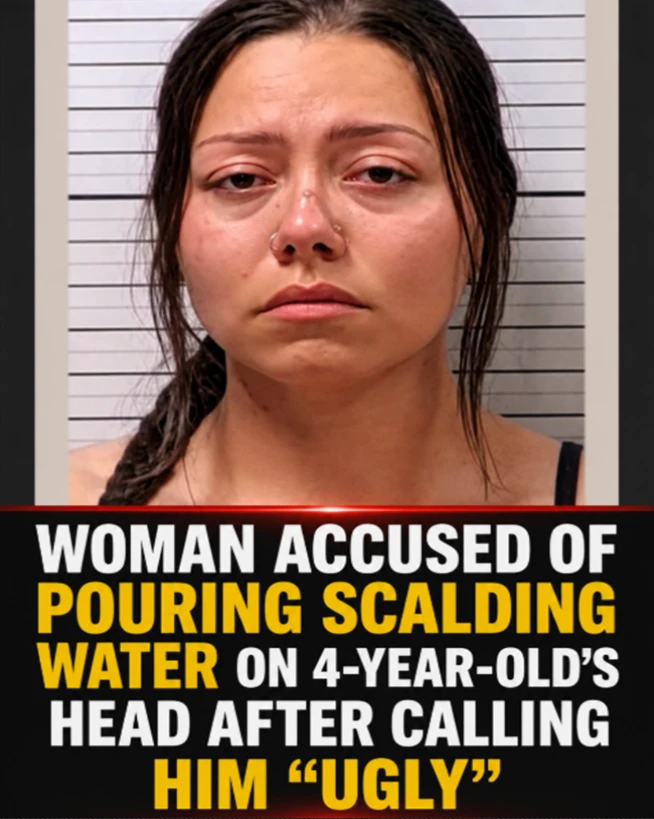
Woman Accused of Pouring Scalding Water on 4-Year-Old’s Head After Calling Him “Ugly”.929

A 26-year-old Wyoming woman is facing a felony child abuse charge after a 4-year-old boy was hospitalized with severe burns and a series of other injuries that authorities say may point to prolonged abuse rather than a single household accident. Investigators allege that Richellena Monroy poured scalding water over the child’s head and ear after calling him “ugly,” then later tried to explain the injury as an accident that happened while she was preparing oatmeal.
The case began to draw serious attention after the young boy was taken for medical treatment with significant burns. According to investigators, Monroy initially told medical staff that the child had been injured when hot water accidentally splashed on him while she was making oatmeal. However, hospital personnel reportedly became suspicious almost immediately after examining the boy more closely.
Doctors and medical staff allegedly found far more than a burn injury.
The child reportedly had bruises, abrasions, and other injuries across different areas of his body. Authorities said some of the injuries appeared to be in different stages of healing, raising concerns that the boy may have been hurt repeatedly over an extended period rather than during one isolated incident.
Medical testing reportedly revealed even more troubling findings. A CT scan allegedly showed signs consistent with possible brain hemorrhages, a scalp hematoma, and a potential skull fracture. Those findings intensified concerns among investigators and medical professionals about what the child may have experienced before arriving at the hospital.
Authorities began examining whether the explanation involving oatmeal could account for the severity and pattern of the injuries.

According to reports on the investigation, specialists later determined that the third-degree burns affecting the child’s ear did not appear consistent with an accidental splash. His condition reportedly worsened to the point that he had to be flown to a specialized burn center for advanced medical care.
The case took an even more disturbing turn after the child was removed from Monroy’s care and placed into protective custody.
Once he was in a safer environment, the boy reportedly began describing what he said had happened to him. According to investigators, he told a foster parent that Monroy had poured hot water on his ear because she said he was “ugly.”
The child also reportedly made another serious allegation, saying that Monroy had thrown him down a flight of stairs.
Those statements, combined with the medical evidence, became central to the investigation. Authorities began piecing together a picture that they allege involved far more than an accidental burn in a kitchen.
For investigators, one of the key questions is how the child suffered so many different injuries and whether they can be explained by accidents, as the defense has suggested, or whether they represent a pattern of intentional harm.
The boy’s age makes the allegations especially difficult to hear. At just 4 years old, he would have been almost entirely dependent on the adults around him for safety, food, medical care, and protection. Instead, authorities allege that he suffered serious injuries while under the care of someone responsible for looking after him.
Child abuse investigations involving very young children can be particularly complex. Young children may struggle to explain events clearly, remember exact timelines, or understand the significance of what happened to them. Because of this, investigators often rely heavily on medical findings, statements made to trusted adults, forensic interviews, and evidence showing whether injuries are consistent with the explanations provided by caregivers.
In this case, the medical evidence appears to be one of the most important parts of the prosecution’s case.
The alleged third-degree burns were reportedly examined by specialists at a burn center, who concluded that the injuries did not appear accidental. Third-degree burns are extremely serious because they can destroy multiple layers of skin and sometimes damage underlying tissue. Injuries to the ear and head can also require specialized treatment and may leave lasting physical effects.
At the same time, the other reported injuries—including bruising, abrasions, possible bleeding around the brain, a scalp hematoma, and a possible skull fracture—raised broader concerns about what may have happened before the burn incident.
Authorities have not publicly detailed every injury or established exactly when each one allegedly occurred. Those questions are expected to become a major part of the ongoing criminal proceedings.
Monroy, however, has not been convicted of the allegations and is entitled to defend herself in court.
During a recent hearing, defense attorney Branden Vilos said Monroy intends to fight the accusations against her. He argued that she has provided explanations for the child’s injuries and emphasized that the existence of serious injuries does not automatically prove that his client intentionally caused them.
Vilos also pointed to Monroy’s lack of a prior criminal history. He told the court that she voluntarily reported to authorities before her arrest, suggesting that she had not attempted to flee or avoid the investigation.
Prosecutors, however, sought a substantial bond, reportedly requesting $150,000 cash only.
Judge Joey Darrah ultimately set Monroy’s bond at $125,000 cash or surety, allowing for a slightly less restrictive condition than prosecutors had requested. The bond amount reflects the seriousness of the charge while the case continues through the court system.
Monroy is scheduled for a preliminary hearing on July 22.
At that stage, the court is expected to consider whether prosecutors have presented enough evidence for the felony child abuse case to proceed. The hearing will not determine final guilt or innocence, but it could reveal more details about the evidence investigators have collected.
The case has already raised difficult questions about how long the child may have been suffering and whether there were any earlier signs that could have led to intervention.
If the allegations are proven, the statement attributed to the boy—that scalding water was poured on him because he was called “ugly”—would be particularly disturbing. It would suggest that a young child suffered severe physical harm over something entirely beyond his understanding or control.
But investigators must still prove what happened through evidence.
The defense may challenge the child’s statements, question how they were obtained, dispute the medical interpretation of the injuries, or offer alternative explanations for how some of the harm occurred. Prosecutors, in turn, are likely to rely on medical specialists, investigators, and the child’s reported disclosures to argue that the injuries could not reasonably have resulted from the accident Monroy initially described.
For now, the most important development is that the boy is no longer in the environment where authorities believe the injuries occurred. He has been placed in protective custody while receiving care for injuries that doctors reportedly consider serious.
The case now moves toward its next legal stage, where more evidence may become public and the competing explanations will begin to be tested.
What started as a reported oatmeal accident has evolved into a felony child abuse investigation involving third-degree burns, possible head trauma, multiple injuries in different stages of healing, and the disturbing words allegedly spoken by a 4-year-old after he was removed from the home.
Whether prosecutors can prove those allegations beyond a reasonable doubt remains for the courts to decide. But the medical findings and the child’s reported statements have already transformed this case into something far more serious than an accidental kitchen injury—and the preliminary hearing may reveal just how much investigators believe happened before the boy was finally taken to safety.