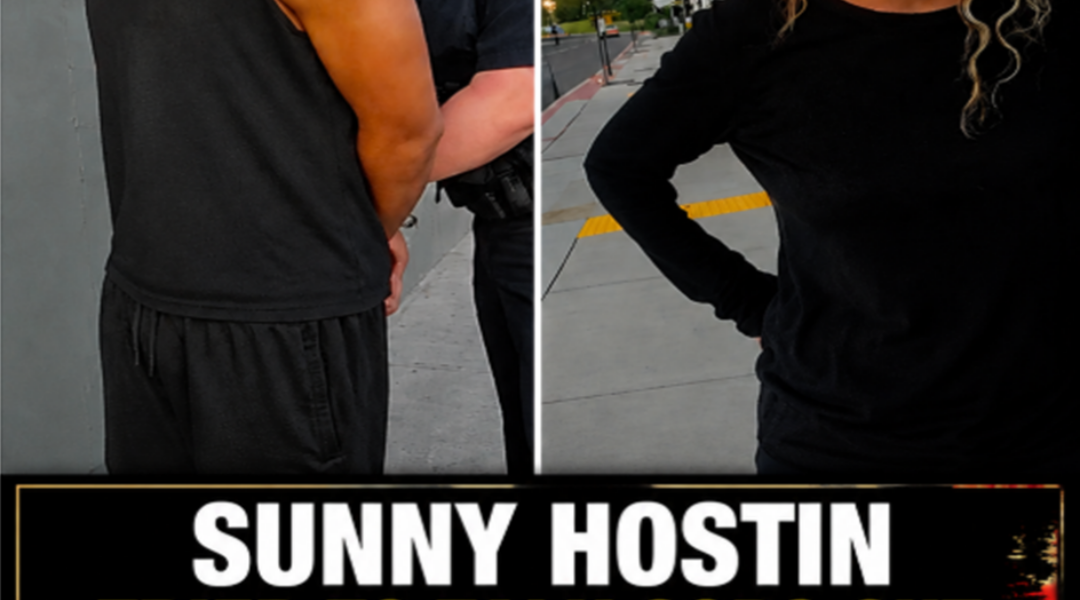
SUNNY HOSTIN TRIED TO TALK POLICE OUT OF CITING HER HARVARD-EDUCATED SON FOR TRESPASSING: “HE HAS NO CRIMINAL RECORD”.925

Sunny Hostin, co-host of The View and a former federal prosecutor, is facing renewed public attention after police body-camera footage reportedly showed her trying to persuade officers not to cite her 24-year-old son, Gabriel Hostin, for trespassing near active Metro-North railroad tracks. During the exchange, Hostin emphasized her son’s clean record, his Harvard education, and her own legal background, arguing that the incident was an innocent mistake rather than conduct deserving further punishment. The confrontation has since sparked a wider debate over privilege, parental advocacy, police discretion, and whether a person’s education or family connections should matter when authorities enforce the law.

The incident occurred on June 16 in New Rochelle, New York. According to court records and subsequent reporting, Gabriel Hostin was jogging when officers encountered him in an area connected to the Metro-North Railroad right-of-way. Authorities said the location was restricted and marked with “No Trespassing” warnings. Gabriel was ultimately issued a trespassing violation, but he was not formally arrested or fingerprinted. He is scheduled to appear in court on July 31.
Hostin has disputed the suggestion that her son knowingly ignored clear warnings. In a letter seeking dismissal of the case, she wrote that Gabriel is a 2025 Harvard University graduate, has no criminal history, and had never previously been involved with the criminal justice system. She also described him as an avid runner and former Junior Olympian track athlete who was training in the area at the time. According to her account, Gabriel saw a gravel incline that appeared suitable for hill training and entered through gates that were standing open. Hostin maintained that no clearly visible warning sign alerted him that he was entering restricted railroad property.
The controversy intensified after body-camera footage of the police encounter was reported. Hostin could reportedly be heard identifying herself as a co-host of The View and a former federal prosecutor while speaking with officers. She also stressed that Gabriel was a Harvard graduate and had no criminal record. Critics quickly accused her of using celebrity status and elite credentials to obtain favorable treatment for her son. Supporters, however, argued that parents routinely advocate for their children and that mentioning a clean record is not unusual when asking officers or prosecutors to exercise discretion in a minor case.

Importantly, the available reporting indicates that Gabriel was cited rather than arrested. Some headlines and social media posts have described him as being “busted” or “arrested,” but reports from People, USA Today-linked coverage, and TMZ state that the incident resulted in a trespassing citation and no formal arrest. That distinction matters, particularly because much of the online reaction has portrayed the encounter as more severe than the court record appears to show.
Still, the underlying allegation is not trivial. Railroad rights-of-way and active tracks are dangerous environments, and trespassing restrictions exist to prevent collisions, injuries, and fatalities. Even someone who intends only to jog or explore an area can place themselves at risk when entering railway property. Police officers encountering a person near active tracks may therefore have legitimate safety concerns regardless of that person’s background, education, or intentions.
The key legal question, however, is whether Gabriel knowingly entered a restricted area or reasonably believed the location was open to the public. Hostin’s defense centers on the open gate and allegedly unclear signage. She has argued that her son made an “honest mistake” and that continuing the prosecution would serve little public interest. In her letter, she emphasized that Gabriel had worked hard to build a strong academic and personal record and posed no risk to the community.
Critics see that argument very differently. They question why a Harvard degree or athletic achievements should be relevant to a trespassing violation. From their perspective, mentioning those accomplishments risks suggesting that highly educated or well-connected defendants deserve more leniency than ordinary people facing the same accusation. Some commentators have also criticized Hostin for referring to her own public identity while interacting with police, saying the episode illustrates how fame can influence encounters with authorities.
Others have pushed back against that interpretation. They argue that defense attorneys routinely present mitigating factors, including a defendant’s lack of criminal history, cooperation with police, employment, education, and community record. In that sense, Hostin’s argument is not fundamentally different from what many lawyers would do when asking prosecutors to dismiss a low-level offense or resolve it without lasting consequences. Her dual role as both Gabriel’s mother and his attorney, however, has made the situation far more visible and emotionally charged.
The body-camera footage also raises questions about police discretion. Officers routinely make decisions about whether to issue warnings, citations, or make arrests depending on the circumstances. According to reporting on the encounter, Gabriel’s conduct and background were discussed as officers considered how to handle the situation. The fact that he ultimately received a citation rather than facing a more severe outcome shows that discretion was already part of the encounter, though the exact reasoning of the officers has not been fully detailed publicly.

For Sunny Hostin, the controversy is particularly sensitive because she has spent years publicly discussing criminal justice, race, policing, and equality under the law. Critics therefore argue that her handling of her son’s situation deserves scrutiny. They ask whether she would defend another parent for emphasizing a child’s elite education and clean record to police. Her supporters counter that there is no contradiction between advocating for equal justice and arguing that a minor, nonviolent incident involving no criminal history should be resolved with leniency.
The debate has also become a reflection of how quickly relatively small legal matters can become national stories when public figures are involved. Had the same trespassing citation involved an unknown family, it might never have received attention beyond a local court docket. But because Sunny Hostin is a nationally recognized television personality and former prosecutor, every word she used with officers has been examined for evidence of influence, entitlement, or hypocrisy.
At the center of the case, however, remains a fairly narrow factual dispute. Gabriel Hostin says, through his mother and attorney, that he was running, saw an open gate, and did not realize he was entering restricted railroad property. Authorities say he was in an area where trespassing was prohibited. The court will ultimately decide whether the violation should stand or whether the circumstances justify dismissal.
Hostin has already made clear where she stands. She believes her son’s actions were an honest mistake and has asked prosecutors to drop the case before his scheduled July 31 appearance. Whether they agree may depend on the evidence surrounding the signage, access point, and Gabriel’s conduct when officers approached him.
For now, the controversy continues to generate strong opinions on both sides. Some see a mother using every available credential to protect her son from consequences. Others see a lawyer doing exactly what lawyers are expected to do—presenting mitigating facts and arguing that a first-time, low-level offense does not warrant continued prosecution.
What began as a routine jog near railroad property has now become a public test of how Americans view privilege, fairness, and prosecutorial discretion. The most revealing part of the story may not be the trespassing citation itself, but whether Sunny Hostin’s arguments would carry the same weight if the person involved were not her son—and whether the court ultimately decides that his clean record and claimed mistake are enough to make the case disappear.