“We Gotta Ban These Dadgum Things”: Rep. Tim Burchett Targets Flock Cameras With New Federal Surveillance Bill.956

A growing national fight over automated surveillance cameras has now reached Congress. U.S. Rep. Tim Burchett of Tennessee introduced legislation that would sharply restrict the federal government’s ability to purchase, operate or access systems capable of tracking people through license plates, facial recognition, biometric information and other identifying data. The proposal, officially titled the Protection Against Mass Surveillance Act, was introduced in the House on July 21, 2026, as H.R. 9800 and has been referred to the House Committee on Oversight and Government Reform.
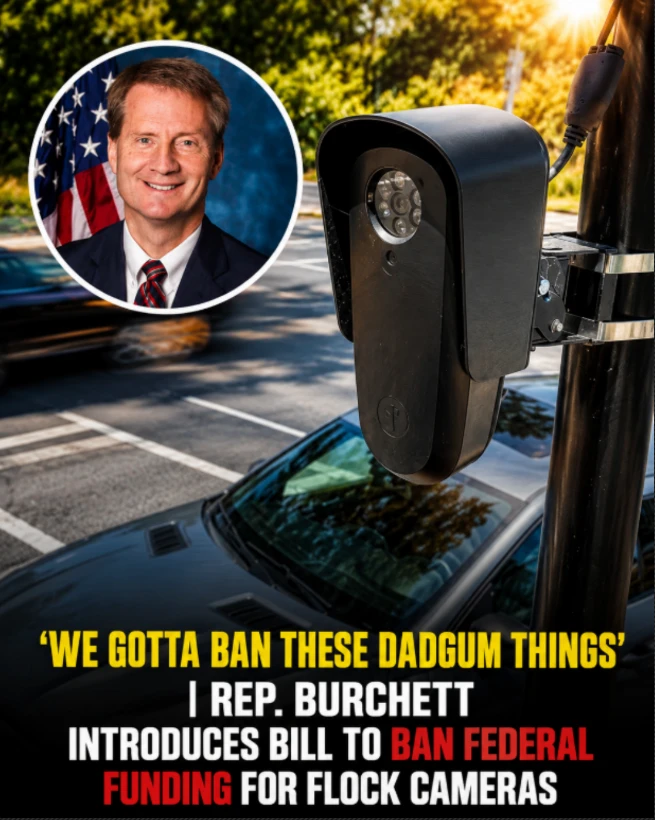
Burchett’s message was blunt. Speaking about Flock Safety cameras and similar technology, he argued that Americans should not be forced to choose between public safety and personal liberty. He has repeatedly framed the issue as a constitutional one, saying that the increasing use of automated surveillance risks allowing government agencies to monitor ordinary people without sufficient limits or oversight. In a video posted after introducing the bill, Burchett summed up his position in characteristically direct language: “We gotta ban these dadgum things.” WVLT reported that he also said he had been discussing the issue with Knox County Mayor Glenn Jacobs, who has raised his own concerns about privacy and civil liberties.
The legislation goes significantly beyond simply targeting one brand of license plate reader. Under the bill, no federal agency would be allowed to purchase, deploy, operate, access or contract for an automated surveillance system that identifies, tracks or records individuals using several specified technologies. The first category explicitly includes automated license plate recognition systems, and the text specifically names Flock Safety cameras. It would also prohibit federal agencies from using facial recognition systems and biometric identification technology involving fingerprints, iris or retinal scans, voice recognition, gait analysis or other personally identifiable biological characteristics.
The bill contains an even broader fourth category covering technology that captures, analyzes or keeps a person’s image, likeness or other personally identifiable information for the purpose of persistent or mass surveillance. That language shows the proposal is intended to address a wider technological ecosystem rather than just roadside cameras.
State and local governments would also feel the effects if the legislation became law. H.R. 9800 would prohibit state, local and Tribal governments from using federal funds to purchase, operate, access or contract for the same types of surveillance systems. It would not, based on the introduced text, simply outlaw every locally funded camera in America. Instead, one of its major mechanisms is cutting off federal money from supporting these technologies.
The proposal also addresses what happens when federal agencies obtain data in violation of the ban. The head of the agency would be required to delete the information within 30 days, and data obtained in violation of the prohibition could not be admitted as evidence in a court or administrative proceeding. Those provisions could become particularly significant because they would give the bill consequences beyond procurement rules: illegally obtained surveillance data could become unusable in legal proceedings.
At the center of the controversy are automated license plate readers, commonly known as ALPRs. Flock Safety has become one of the most visible companies in that field. Its roadside cameras capture vehicle information, including license plates, and allow participating law-enforcement agencies to search for vehicles connected to investigations. Supporters say that capability can help police locate stolen cars, identify vehicles associated with crimes and quickly follow leads that might otherwise take officers hours or days to develop.
Critics see something very different.
Because cameras can photograph enormous numbers of vehicles traveling ordinary public roads, privacy advocates argue that networks of ALPR cameras can effectively create databases showing where vehicles have been and when. Their concern is not necessarily about a camera being used to find a single stolen vehicle. The larger concern is what becomes possible when thousands of cameras operate together and agencies can search those records across jurisdictions.
That debate has intensified nationwide. The Guardian reported in July 2026 that Flock says its systems scan license plates billions of times every month in roughly 6,000 communities across almost every state. Opposition has grown at the same time, with privacy advocates questioning whether widespread ALPR networks amount to mass surveillance and whether safeguards are strong enough to prevent misuse.
Some of the concern comes from documented allegations that law-enforcement personnel have improperly used databases for personal reasons. Burchett specifically referenced reports of officers allegedly accessing surveillance technology for inappropriate purposes, including looking up women for personal or dating-related reasons. For him, cases like those illustrate what can happen when a powerful tracking tool exists without sufficient safeguards.
His position is straightforward: technology initially justified as a crime-fighting tool can become something much broader once it creates a searchable record of ordinary citizens’ movements.
But law-enforcement supporters of Flock cameras strongly dispute the idea that the technology should simply be characterized as unconstitutional surveillance.
Police departments around the country say license plate readers have helped recover stolen vehicles, locate suspects and solve burglaries, robberies and other crimes. Flock itself has argued that its products are public-safety tools rather than systems designed to track individual people. The company has said the technology primarily captures vehicle information visible from public roads.
That creates the central tension behind Burchett’s bill.
Imagine investigators know the license plate of a vehicle connected with an abduction, armed robbery or missing child. A network of license plate readers can potentially identify where that vehicle was last seen almost instantly. To police departments, that speed may save lives.
But now consider the same network being used to repeatedly search the movements of someone who has never been accused of a crime.
The technology is the same.
The purpose is different.
And Burchett’s argument is that government should not build a surveillance infrastructure powerful enough to make the second scenario routine simply because the first scenario can be useful.
The controversy has become particularly visible in Tennessee. Knox County officials had been preparing for a rollout involving hundreds of Flock cameras, and the proposal generated questions from elected officials over how the cameras would be used, what data would be collected and who would have access. A planned Knox County Commission meeting to discuss the rollout was later canceled, but concerns surrounding the technology have continued.
Knox County Mayor Glenn Jacobs has publicly raised concerns about privacy and civil liberties, putting him broadly on the same side of the issue as Burchett despite the fact that surveillance debates often cross traditional partisan boundaries.
That may be one of the most interesting aspects of the Flock controversy.
Opposition does not fit neatly into a left-versus-right political divide.
Civil-liberties organizations worry about government monitoring. Libertarians object to warrantless tracking. Some conservatives view widespread surveillance as an expansion of government power inconsistent with constitutional freedoms. Meanwhile, many police agencies and public-safety advocates argue the technology is simply a modern version of observing vehicles traveling publicly visible roads.
The legislation is still at the very beginning of the federal process.
H.R. 9800 has not become law. It has been introduced and referred to the House Committee on Oversight and Government Reform. From there, it would need to advance through the legislative process, pass both chambers of Congress in identical form and receive presidential approval before its restrictions could take effect.
That means Flock cameras are not suddenly being banned nationwide because Burchett introduced the proposal.
But the bill itself is significant because a debate that was previously unfolding in city councils, sheriff’s offices and local community meetings is now being framed as a federal policy question.
How much surveillance should government be permitted to conduct simply because technology makes it possible?
How long should location data be stored?
Who should be allowed to search it?
Should police need a warrant?
And should taxpayers fund a system capable of documenting the movements of millions of people who are not suspected of any crime?
Those questions are likely to become more important as surveillance technology becomes cheaper, more powerful and increasingly connected across jurisdictions.
For Burchett, however, the principle is already clear.
Public safety matters.
But so does the ability of Americans to travel through their communities without feeling that every movement is being permanently recorded and made searchable by government agencies.
His legislation attempts to draw that boundary by targeting federal purchasing, federal access and federal funding for some of the most powerful automated surveillance systems now available.
Whether Congress agrees remains uncertain.
But with Flock cameras spreading across the country and backlash growing alongside them, the debate is no longer just about cameras mounted on roadside poles.
It is about a much larger question:
How much privacy should Americans be willing to surrender in the name of safety—and who gets to decide when surveillance has gone too far?