
From Sleeping Beside Her Husband’s Grave to Finally Having a Home: Rhea Holmes’ Remarkable Second Chance.952

For months, Oakwood Cemetery in Syracuse, New York, was the closest thing Rhea Holmes had to a home. At 55, after losing her husband, her job and eventually the roof over her head, she found herself sleeping near the grave of the man she had shared 26 years of marriage with. She did not make a spectacle of her situation. She did not stand on a corner asking strangers for help. In fact, people around her had little idea of how desperate things had become. Rhea later explained that after everything in her life fell apart, the cemetery felt like the only place where she still belonged. “I was living at my husband’s grave for eight months,” she told CNN. “My whole life was turned upside down.”

Her husband, Eddie Holmes, had been a minister, musician and security guard. The couple had been married for 26 years and had dreamed of owning a modest home together. But Eddie died suddenly in 2020, and the loss devastated Rhea. According to accounts of her story, she fell into a deep depression, lost her job as an administrative assistant and was eventually evicted. As her stability disappeared, she resisted telling others how bad things had become because she did not want people to worry about her. With nowhere else that felt safe, she began sleeping at Oakwood Cemetery, near the graves of her husband and father.
Rhea survived there quietly for months. Reports said she slept on a tarp over or near Eddie’s grave, kept a small amount of food nearby and used facilities in the surrounding area to take care of basic needs. She avoided shelters, saying she felt safer on her own. Yet even while she was struggling to survive, she continued volunteering at food pantries and churches. That detail says a great deal about the woman at the center of the story: she had almost nothing, but she still found ways to give something to other people.
Everything began to change because of an ordinary act of kindness.
In December 2025, Syracuse police officer Jamie Pastorello noticed Rhea struggling up a hill with groceries. He stopped and offered her a ride. She told him she was going to the cemetery to visit her late husband. Nothing about the encounter immediately suggested that she was homeless. They talked during the ride, and before getting out, Rhea even asked to take a photograph with him. The Syracuse Police Department later shared the photo online as a simple example of holiday kindness.
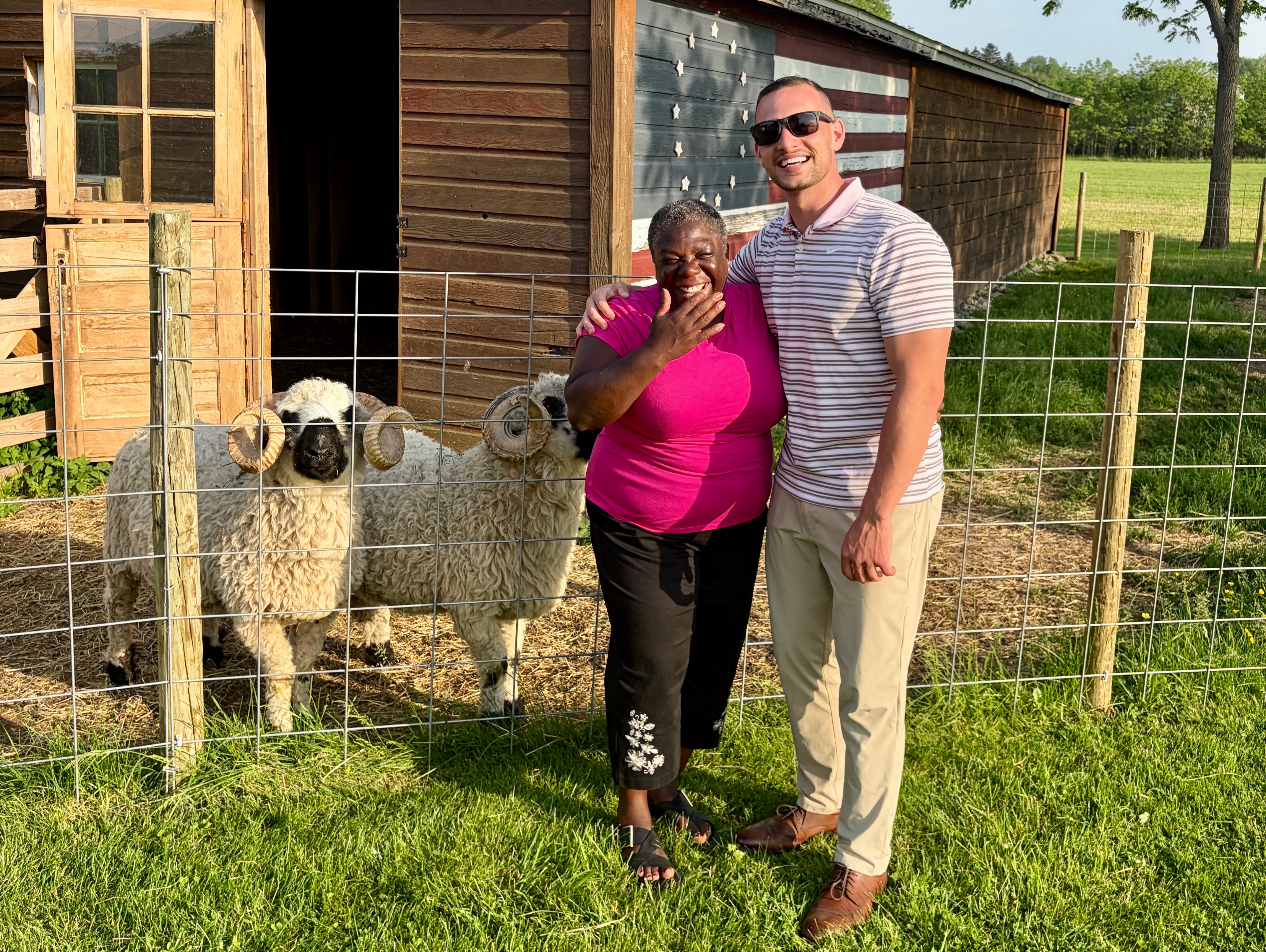
Then someone who worked at the cemetery saw it.
The worker recognized Rhea and contacted authorities with information that stunned Pastorello: she was not simply visiting the cemetery. She had apparently been living there for months.
For the officer, the realization was difficult to process. He had just driven her there believing he was helping a widow visit her husband. Instead, he had unknowingly dropped her off at the place where she would spend another night outdoors.
Pastorello immediately decided that something had to change.
He helped put Rhea in a hotel and began reaching out to people who might be able to find her something more permanent. The story quickly spread through Syracuse. Le Moyne College President Linda LeMura became involved, and the college provided Rhea with temporary housing while a longer-term solution was arranged.
Then the community responded.
A fundraising campaign was launched to help Rhea rebuild her life, and support poured in from people who had never met her. Early reports said tens of thousands of dollars were raised. By later accounts shared around her story, community fundraising surpassed $90,000, giving Rhea a level of financial support and stability that had seemed unimaginable only months earlier.

But money alone was not what Rhea needed most.
She needed a home.
That is where Andrew Lunetta and A Tiny Home for Good entered the picture. Lunetta founded the Syracuse nonprofit after years of working with people experiencing homelessness and seeing the same cycle repeat: people would leave shelters, move into housing they could barely afford or that offered little stability, and soon return to the shelter system. His organization was created around a different idea—provide people with private, affordable housing and continue supporting them after they move in.
Rhea eventually moved into one of the organization’s tiny homes. Le Moyne College reported that she first stayed temporarily in housing connected with the college before transitioning into a permanent tiny home. By January 2026, she was no longer sleeping outside. She had her own space, her own door and, perhaps most importantly, a sense of security she had not felt in years.
The change was profound.
For eight months, Rhea had lived with the uncertainty of where she would sleep and whether she would survive the increasingly cold Syracuse nights. Now she could wake up indoors without wondering what the weather would bring. She could store food. She could lock a door. She could sit quietly without worrying about being moved along.
Those are ordinary things to many people.
To Rhea, they meant everything.
Her journey soon reached an even larger audience. In July 2026, CNN named Andrew Lunetta its first CNN Hero of 2026, highlighting the work of A Tiny Home for Good. Rhea appeared in the feature as one of the residents whose life had been changed by the organization.
During the CNN segment, she offered a simple reminder about homelessness:
“I wish people understood that the homeless population are still human.”
She also described just how quickly life can collapse. “At any time, circumstances can change,” she said.
Rhea understood that better than most.
She had once had a husband, a job and plans to buy a house. Then one devastating loss led to another. Grief became depression. Employment disappeared. Housing disappeared. Eventually, the woman who had once imagined buying a home with her husband was sleeping beside his grave.
It is easy to look at someone experiencing homelessness and assume that a long series of bad decisions must have put them there.
Rhea’s story challenges that assumption.
Sometimes it is one death.
One illness.
One lost paycheck.
One eviction.
Then suddenly the life a person believed was secure no longer exists.
Her story also demonstrates what can happen when someone chooses to stop rather than walk past.
Pastorello could have continued driving the day he saw Rhea carrying groceries. Instead, he stopped.
The cemetery worker could have ignored the photograph. Instead, he called.
Le Moyne College could have said housing was not its responsibility. Instead, it opened a door.
Andrew Lunetta and A Tiny Home for Good could have seen Rhea as another statistic. Instead, they saw someone who deserved dignity and stability.
And thousands of strangers could have scrolled past her story.
Instead, they gave.
Today, Rhea has something that once seemed almost impossible.
A home.
Her words after finally finding stability perhaps capture the transformation better than any fundraising total ever could:
“Peace is now what I have.”
That sentence carries the weight of everything that came before it—the grief, the cemetery nights, the cold, the uncertainty and the fear that she might never find her way back.
More than $90,000 in community support helped change Rhea Holmes’ circumstances. A tiny house gave her shelter. But the heart of her story began with something far smaller and much easier to overlook.
One person noticed another person struggling.
And stopped.
Rhea’s journey from sleeping beside her husband’s grave to sitting safely inside a home of her own is proof that kindness does not always have to begin with something extraordinary.
Sometimes it begins with a ride.
A phone call.
A door opened at the right moment.
And sometimes, one small act is enough to begin changing an entire life.