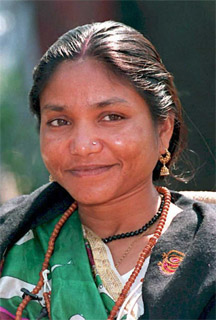
Phoolan Devi’s life began in circumstances that offered her very little protection. Born into a poor Mallah family in rural Uttar Pradesh, India, she grew up at the intersection of poverty, caste discrimination and a deeply patriarchal social order. Accounts of her early life differ on some details, including her exact age at marriage, but they agree on the larger reality: she was married off while still a child to a man considerably older than her. The marriage was abusive, and she eventually returned to her family. Instead of finding safety, however, she entered another period of humiliation, conflict and instability that would shape the rest of her life.
Phoolan belonged to a marginalized lower-caste community, and caste tensions were a constant presence in the world around her. From a young age, she was known for refusing to quietly accept what she considered injustice. That defiance brought consequences. She became involved in family disputes over land, clashed with powerful villagers and was repeatedly treated as someone whose voice mattered little. Her later story would be turned into legend, film and political symbolism, but before all of that, she was a poor rural girl living in a society where wealth, caste and gender could determine almost every part of a person’s future.
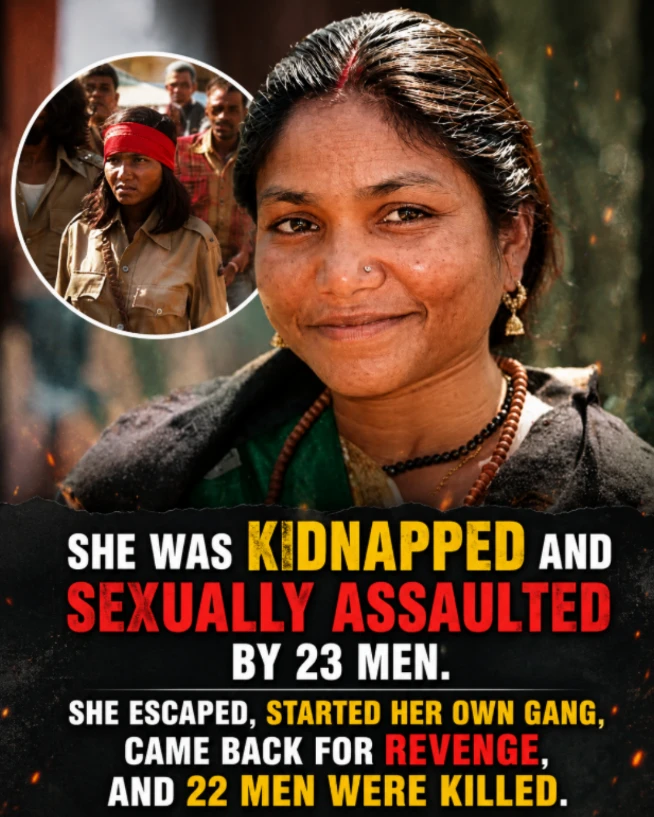
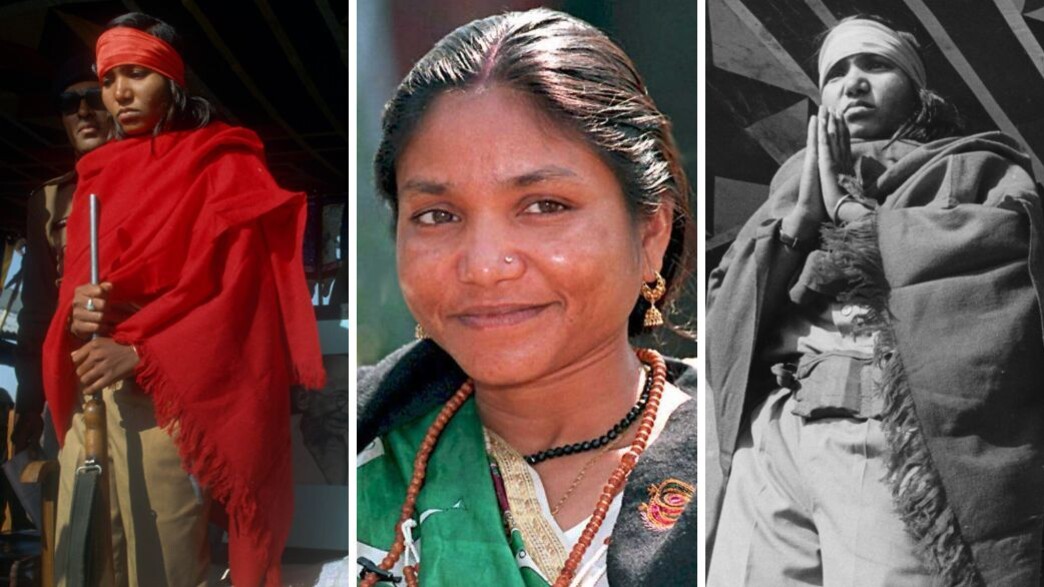
Her life changed dramatically when she became involved with the dacoits who operated in the rugged Chambal ravines. These armed outlaw groups had long used the maze of gullies and remote terrain across parts of northern and central India as hideouts. According to widely reported accounts, Phoolan was abducted by a gang and endured severe physical and sexual abuse. She later became associated with another outlaw, Vikram Mallah, and gradually emerged as a figure of authority within the bandit world.
The transformation was extraordinary. The girl who had repeatedly been controlled by others was now armed and surrounded by men who followed her. Over time, she became leader of her own group and one of the most wanted outlaws in India.
The newspapers gave her a name that would follow her forever:
The Bandit Queen.
But the legend surrounding Phoolan Devi often blurred the line between documented fact and folklore. To some, she became an almost Robin Hood-like symbol of rebellion against caste oppression and male violence. To others, especially families who lost relatives during her years as an outlaw, she was simply the leader of a violent criminal gang.
That conflict is impossible to separate from the most controversial event associated with her name: the Behmai massacre.
In February 1981, Phoolan and members of her gang entered Behmai, a village dominated by members of the Thakur community. According to the prosecution case and surviving witnesses, men from the village were rounded up and a group of them was shot. Contemporary and later reports have differed slightly on the exact number, but court records and more recent reporting generally put the death toll at 20 men, with several others injured.
The attack was widely portrayed as revenge for what Phoolan had endured. Accounts said she had previously been held captive and repeatedly sexually assaulted by upper-caste men connected with Behmai. Yet this part of her story remains more complicated than the popular version sometimes suggests. The men who died were not legally established as the same individuals who had assaulted her, and survivors of the massacre disputed the idea that the killings could simply be described as justice against her attackers.
That distinction matters.
What happened to Phoolan was horrific. But the suffering she endured does not erase the suffering of the families whose relatives were killed at Behmai.
Her story contains both realities.
After Behmai, Phoolan became one of the most intensely hunted fugitives in India. Police launched large operations to capture her, but the difficult terrain of the Chambal ravines allowed her group to remain elusive. Her reputation grew with every story printed about her. Depending on who was telling it, she was a ruthless murderer, an avenger of oppressed women, a lower-caste rebel fighting the powerful, or some uneasy combination of all three.
For nearly two years after Behmai, she remained beyond the reach of authorities.
Then came another dramatic turn.
In February 1983, Phoolan Devi surrendered.
The surrender became a spectacle in itself. She negotiated terms with authorities and surrendered before a large crowd in Madhya Pradesh. Reports said that she had sought guarantees concerning the treatment of herself and members of her gang. What followed, however, was not a quick resolution.
Phoolan spent approximately 11 years in prison.
Despite facing dozens of criminal allegations, including accusations connected to robbery, kidnapping and murder, her cases moved extraordinarily slowly through India’s judicial system. She was never convicted over the Behmai massacre during her lifetime. In 1994, she was released after the government of Uttar Pradesh withdrew cases against her in what officials described as the public interest. The decision was deeply controversial, particularly among families in Behmai who had waited years for a trial.
After 11 years behind bars, almost anyone could have expected Phoolan Devi to disappear from public life.
She did the opposite.
She entered politics.
The transformation seemed almost impossible: a woman once pursued by thousands of police officers was now asking voters to send her into the Lok Sabha, the lower house of India’s Parliament.
Phoolan joined the Samajwadi Party, which had built strong support among lower-caste and marginalized communities. Her background made her an unusually powerful political symbol. She could speak about poverty, caste discrimination and the vulnerability of women not as abstract political concepts but as experiences that had defined her own life.
In 1996, voters in Mirzapur elected Phoolan Devi to Parliament.
The Bandit Queen had become a lawmaker.
It was one of the most remarkable political transformations modern India had witnessed.
The woman who had once lived in the ravines carrying a firearm was now walking into Parliament as an elected representative. She lost her seat in the 1998 election but returned again after winning in 1999. Supporters saw her rise as proof that someone born at the very bottom of India’s social hierarchy could force her way into the country’s political establishment.
Her political priorities reflected her past. She spoke about the rights of women, lower castes and poor communities. She remained controversial, however. Families connected with the Behmai killings continued demanding justice, arguing that her reinvention as a politician should not erase the accusations surrounding her past. The Behmai case would drag on for decades, long after Phoolan herself was gone. In 2024, more than four decades after the massacre, a court handed down the first conviction in the case against a surviving accused.
Phoolan never had the opportunity to see how the long legal battle would end.
On July 25, 2001, she returned to her residence in New Delhi after attending Parliament. Gunmen were waiting outside.
They opened fire at close range.
Phoolan Devi was struck repeatedly and died from her wounds. Her bodyguard was also injured. She was still a sitting Member of Parliament.
The killing immediately raised suspicions that the violence of her past had finally caught up with her. Sher Singh Rana later claimed responsibility and portrayed the assassination as revenge for the Behmai massacre. He was eventually convicted of Phoolan Devi’s murder and sentenced to life imprisonment in 2014.
Her story therefore ended almost as violently as much of her life had unfolded.
But Phoolan Devi remains difficult to place into a simple category.
Calling her only a victim ignores the violence associated with her outlaw years.
Calling her only a criminal ignores the caste oppression, forced child marriage and severe abuse that shaped her life.
Calling her only a political hero ignores the families who spent decades demanding accountability for Behmai.
And reducing her simply to the “Bandit Queen” turns a complicated human life into a legend.
She was a child bride.
She was abused.
She was kidnapped.
She became an outlaw.
She was accused of participating in one of India’s most notorious massacres.
She surrendered.
She spent 11 years behind bars.
And then, in a transformation almost nobody could have predicted, she became an elected Member of Parliament.
For supporters, Phoolan Devi represented resistance—the idea that a poor, lower-caste woman could refuse to remain powerless in a society that repeatedly tried to determine her place for her. For her critics and the families of Behmai, her story could never be separated from violence and unanswered demands for justice.
Both realities remain part of her legacy.
Phoolan Devi’s story is not a clean tale of heroism, and it should not be rewritten as one. It contains suffering and survival, but also vengeance, alleged crimes and lives that could never be returned. It is precisely those contradictions that have kept people debating her decades later.
The world repeatedly tried to give her a single identity.