Robert DuBoise: 37 Years Taken by a Conviction Built on Evidence That Failed.947

Robert DuBoise was only 18 years old when his life became tied to a crime he insisted he had never committed. In 1983, 19-year-old Barbara Grams was sexually assaulted and killed while walking home from work in Tampa, Florida. Investigators eventually focused on DuBoise, a young man who did not know Grams but had been known to spend time in the area where her body was discovered. What followed would become one of Florida’s most disturbing wrongful-conviction cases: a prosecution built heavily on bite-mark evidence now widely regarded as unreliable and testimony from a jailhouse informant that was later discredited. DuBoise would spend 37 years behind bars before DNA evidence finally proved he was not responsible.
At the center of the prosecution was a wound on Grams’ cheek that a medical examiner believed was a human bite mark. Investigators obtained dental impressions from several men, including DuBoise. A forensic odontologist concluded that DuBoise’s teeth matched the supposed bite. At the time, bite-mark comparison was presented in courtrooms with a level of confidence that would later come under intense scientific criticism. Decades later, even the dentist involved in DuBoise’s case acknowledged that he no longer believed a bite mark could be reliably matched to one individual.
The second major piece of evidence came from a jailhouse informant who claimed DuBoise had confessed to killing Grams. That testimony gave prosecutors something the physical case could not provide: an alleged admission of guilt. Yet the informant’s account was ultimately discredited. There was no DNA tying DuBoise to the crime, and the two central pillars presented against him—the supposed bite-mark match and the alleged confession—would both collapse under later scrutiny.
Nevertheless, it was enough to convict him.
DuBoise was found guilty of first-degree murder and attempted sexual battery. The consequences could hardly have been more severe. He was initially sentenced to death, meaning an 18-year-old who maintained his innocence was facing execution on evidence that would decades later be exposed as deeply unreliable. His death sentence was eventually reduced to life imprisonment, but that did little to restore what had already been taken from him. He remained behind bars as his twenties passed, then his thirties, forties and much of his fifties.

For years, DuBoise continued to insist that he had been convicted of something he did not do. But once a conviction becomes final, proving innocence can become extraordinarily difficult. Witness memories fade, evidence may disappear, legal options narrow and courts often treat old cases as settled. The world outside prison continued changing while DuBoise remained inside.
The technology that would ultimately free him had not been available when the case was prosecuted in the early 1980s. DNA testing transformed criminal investigations in the decades that followed, allowing biological evidence to establish connections—or exclusions—that older forensic methods could never reliably provide.
In 2018, the Innocence Project became involved and prosecutors agreed to reexamine the case. Biological evidence associated with the investigation was eventually located and subjected to modern DNA testing. The results fundamentally changed everything.
The DNA did not belong to Robert DuBoise.
Instead, testing excluded him and pointed toward two other men. The evidence that had been unavailable to the jury decades earlier now provided what DuBoise had spent most of his adult life trying to prove: he was not the man responsible for the crime. The two men later linked through DNA were Amos Robinson and Abron Scott, both already serving life sentences in connection with another killing.
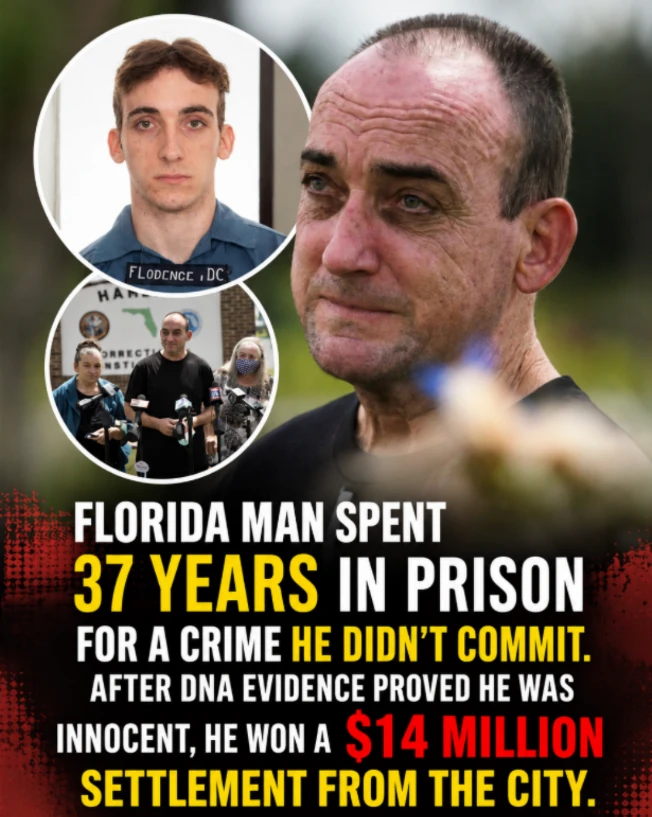
On August 26, 2020, DuBoise walked out of prison.
He had entered the system as a teenager. He came out in his mid-fifties.
Thirty-seven years had disappeared between those two moments.
There was no way to return the birthdays he had missed, the friendships that had changed, the family moments that had passed without him or the ordinary experiences most people barely notice until they are gone. Freedom had finally arrived, but it arrived almost four decades late.
A month after his release, the prosecution formally dropped the case against him. DuBoise spoke about how difficult it had become to trust the justice system after encountering so many obstacles, but he also expressed gratitude toward the people who finally helped correct the injustice.
His legal fight, however, was not finished.
In 2021, DuBoise filed a federal civil rights lawsuit against the City of Tampa, several police officers and the forensic odontologist involved in the original prosecution. His lawsuit alleged that fabricated evidence and false testimony helped cause his wrongful conviction. The city later denied that its officers had engaged in intentional wrongdoing, but eventually agreed to resolve the case through a massive settlement.
In February 2024, the Tampa City Council unanimously approved a $14 million settlement for DuBoise. Under the agreement, the money was structured in installments: $9 million in 2024, $3 million in 2025 and another $2 million in 2026. City officials openly acknowledged the enormous harm caused by the wrongful conviction.
Fourteen million dollars is an extraordinary amount of money.
But 37 years is an extraordinary amount of life.
DuBoise himself understood that distinction. After the settlement was approved, he made clear that money, homes and possessions could never restore what had been taken from him. Yet remarkably, he also said he did not want to spend the rest of his life consumed by bitterness. He had found work doing maintenance and repair jobs and spoke about buying a home and simply moving forward.
That attitude may be one of the most striking parts of his story.
A system had once sentenced him to die. It then kept him imprisoned for nearly four decades. By the time science finally caught up with the truth, more than half of his life had already been taken.
The case is also a warning about what can happen when forensic evidence is treated as more certain than the science actually supports. Bite-mark analysis once carried enormous influence in American courtrooms. In DuBoise’s case, an alleged match helped place a teenager on death row. Decades later, DNA evidence demonstrated just how dangerously wrong that conclusion had been.
And the consequences extended beyond DuBoise. When investigators become convinced that they have found the right suspect and unreliable evidence reinforces that belief, the actual perpetrators may remain free. Wrongful convictions therefore do not only punish innocent people—they can also prevent victims and their families from receiving genuine answers.
Robert DuBoise eventually received something many wrongfully convicted prisoners never do: freedom, official exoneration and substantial compensation. But none of those things can recreate the life he would have lived.
He was 18 when the justice system took him away.
He was 55 when DNA finally helped bring him home.
The $14 million settlement acknowledged the magnitude of what happened, but no check can restore 37 years of freedom. No court order can recreate his twenties, thirties or forties. No apology can return the ordinary mornings, family gatherings and quiet moments that disappeared behind prison walls.
Robert DuBoise finally received justice.
The tragedy is that the truth had been waiting for him for nearly four decades.
When justice arrives 37 years late, it is difficult to call it justice arriving on time.