
Three Tampa Teens Accused of Targeting Homeless People “For Entertainment,” Leaving Man in His 60s Fighting for His Life.940

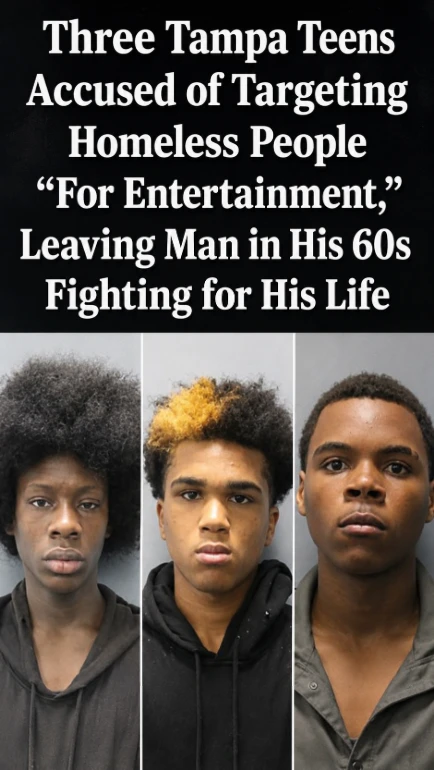
Three teenagers in Tampa are facing extraordinarily serious criminal charges after police say they deliberately set out to harass and attack homeless people because they were “bored,” turning an early-morning outing into a series of violent assaults that left one man critically injured with a traumatic brain injury. The suspects have been identified by Tampa Police as 13-year-old Samari Bryant, 14-year-old Corliss Sirmons and 16-year-old Javonnie Council. Police allege the teenagers specifically targeted vulnerable people experiencing homelessness, and some of the charges include a prejudice element.

According to the Tampa Police Department, the violence unfolded during the early morning hours of July 13, 2026. Investigators say preliminary findings indicate the group had planned to harass and assault homeless people “for entertainment” because they were bored. What allegedly followed was not a single spontaneous confrontation, but two attacks occurring only hours apart and less than a quarter-mile from each other.
The first known incident happened at approximately 2:30 a.m. A white man in his mid-40s and a white woman in her mid-30s were resting when three males approached them. According to police, the suspects began verbally antagonizing the pair before throwing rocks at them. One of the rocks struck the woman in the back of the head. Fortunately, police said she did not suffer serious injuries. The suspects then fled, and the attack was not immediately reported to authorities.
Several hours later, the case took a far more devastating turn.
At approximately 7:45 a.m., Tampa officers conducting proactive patrols discovered a Hispanic man in his mid-60s lying behind a closed business. He was severely injured and unresponsive. Emergency responders transported him to a hospital, where doctors determined that he had suffered critical injuries, including a traumatic brain injury. According to Tampa Police’s July 21 statement, the man remained on a medically necessary ventilator while doctors continued monitoring his condition.
Detectives immediately began investigating how the man had ended up so badly injured. As they reconstructed the morning’s events, investigators connected the critically injured man with the earlier attack involving the man and woman. Statements from the victims of the first incident helped police establish a timeline and obtain initial descriptions of the people they believed were responsible.
The proximity of the two crime scenes also became significant. Police said they were located less than a quarter-mile apart, strengthening investigators’ belief that the attacks were connected. Information and images of the suspected attackers were distributed throughout the police department. An officer subsequently recognized three individuals who appeared to match the people investigators were seeking.
Police identified them as Bryant, Sirmons and Council. But by then, investigators had already encountered the teenagers for an entirely different reason.
Before detectives had fully connected the violent attacks, the three boys and a 16-year-old girl had been taken into custody following an unrelated investigation into multiple vehicle burglaries. During those arrests, officers recovered clothing and other evidence that police say later connected the three boys to the assaults. The girl was not accused of participating in the attacks on the homeless victims.
As investigators pieced together the evidence, they began examining why the victims had allegedly been chosen. According to Tampa Police, preliminary findings suggested something particularly disturbing: the group had allegedly planned to harass and assault homeless individuals for entertainment because they were “bored.”

That alleged motive became a major element of the case.
The charges announced by Tampa Police include offenses described as “evidencing prejudice.” The department’s official statement says Bryant and Council were initially charged with attempted murder, aggravated assault with a deadly weapon evidencing prejudice, and aggravated battery with a deadly weapon. Sirmons was later charged with attempted murder and two counts of aggravated assault with a deadly weapon evidencing prejudice.
This distinction matters because reports describing the case simply as a “hate crime” can obscure the precise language used by authorities. Tampa Police describe a hate crime generally as an underlying criminal offense accompanied by an element of bias, while emphasizing that determining bias requires objective facts uncovered during an investigation.
Bryant and Council were arrested in connection with the attacks on July 16. Bryant also faces unrelated allegations stemming from a separate incident involving an adult woman at a nearby park while officers were detaining him. Police said those additional accusations include battery and exposure of sexual organs.
Sirmons was already being held at the Hillsborough Juvenile Detention Center on unrelated charges when investigators filed the new charges against him on July 21. All three boys, along with the teenage girl who police say was not involved in the assaults, also face six counts of burglary of an unoccupied conveyance stemming from the separate vehicle-burglary investigation.
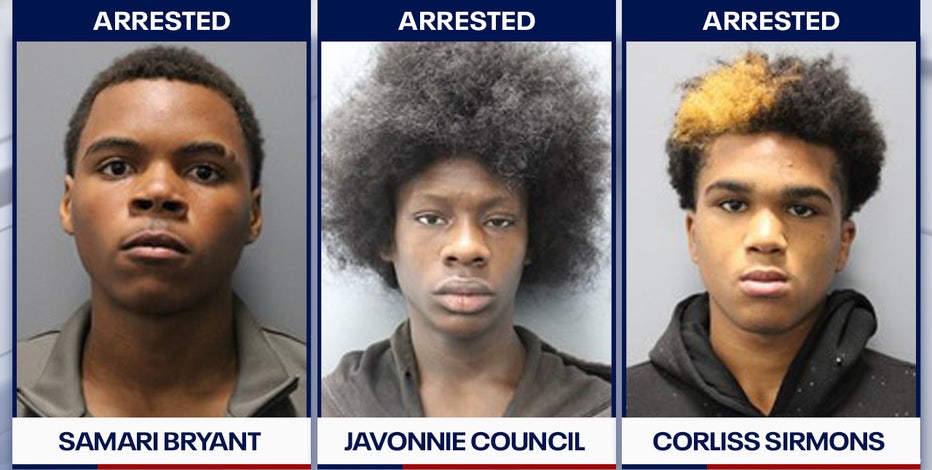
The ages of the suspects have made the allegations even more startling. Bryant is only 13, Sirmons 14 and Council 16. Yet police accuse them of participating in conduct that left a man decades older than them hospitalized in critical condition.
Tampa Police Chief Lee Bercaw expressed particular concern over the alleged motive. He said the suggestion that boredom could be offered as a reason for criminal behavior was alarming, especially when the conduct had escalated to an attempted-murder case. He also stressed that many teenagers in Tampa participate in constructive programs and that boredom cannot excuse such violence.
The critically injured man remains at the center of the case. He was found unable to respond, suffering from severe injuries and requiring mechanical ventilation. What may have begun, according to investigators, as an effort by a group of teenagers to entertain themselves allegedly ended with a man in his 60s fighting to survive.
The case also highlights the particular vulnerability of people experiencing homelessness. Someone sleeping or resting outdoors may have few ways to secure themselves against an unexpected attack. According to police, that vulnerability was not incidental here; investigators believe homelessness itself played a role in why the victims were selected.
Authorities continue to investigate the assaults and have asked anyone with additional information to contact Tampa Police. Investigators will now have to establish exactly what happened during each encounter, the role allegedly played by each teenager, and whether the evidence supports every charge filed against them. As in all criminal cases, the allegations are not findings of guilt, and the accused are entitled to due process.
Yet the central allegation remains deeply disturbing: police say three teenagers, ages just 13, 14 and 16, decided to target vulnerable strangers because they were homeless and because the teenagers were allegedly looking for entertainment. One victim escaped serious injury after being struck in the head with a rock. Another was left with a traumatic brain injury, dependent on a ventilator as doctors fought to keep him alive.
What began with an apparently unrelated vehicle-burglary investigation ultimately helped detectives connect the teenagers to something far more serious. Now, with attempted-murder and prejudice-related charges filed, investigators are working to determine the full extent of what happened during those early morning hours — and whether there may be other victims or evidence that has yet to come to light.