Marco Rubio Faces Backlash After U.S. Suspends Aid Benefiting Somalia’s Government.919

Secretary of State Marco Rubio is facing growing criticism from members of the Somali community and humanitarian advocates after the United States suspended further assistance benefiting Somalia’s federal government. Viral posts have described the decision as an end to “all aid to Somalia,” but the available official reporting presents a more specific picture: the suspension targeted assistance benefiting the government in Mogadishu following allegations involving the seizure and destruction of American-funded humanitarian supplies. The dispute has quickly expanded beyond a disagreement over foreign policy, raising urgent questions about corruption, accountability, national security, and the millions of vulnerable Somali civilians who could suffer when international assistance is disrupted.
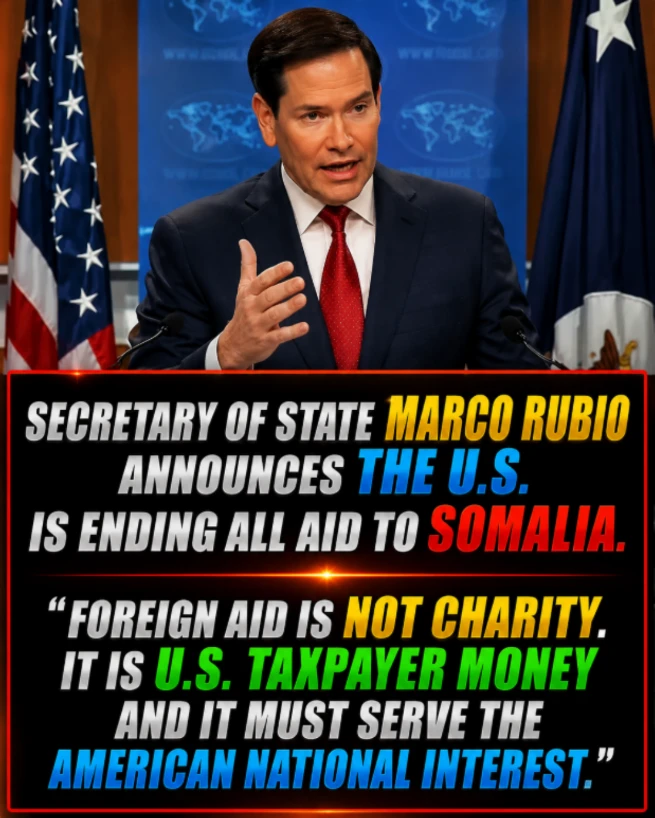
The State Department announced the suspension after accusing Somali government officials of demolishing a warehouse used by the United Nations World Food Programme and illegally taking 76 metric tons of food intended for people facing severe hunger. The warehouse and its supplies had reportedly been supported with American funding. U.S. officials said the administration would not tolerate the theft, waste, or diversion of life-saving aid. According to reporting on the decision, Washington paused assistance that benefited Somalia’s federal government rather than clearly declaring that every form of humanitarian support to every Somali recipient had permanently ended. That distinction is important because some viral graphics and social media posts have framed the policy more broadly than the initial announcement did.
Rubio has repeatedly explained his broader foreign-aid philosophy in direct terms: American assistance is not an unlimited act of charity and must produce a clear benefit for the United States. The administration’s budget documents similarly state that foreign assistance should advance American interests and encourage international partners to accept greater responsibility for their own security and development. Rubio’s approach reflects a significant shift away from the idea that maintaining aid programs is automatically beneficial simply because they serve humanitarian purposes. Instead, every program is expected to demonstrate that it improves U.S. security, strengthens a reliable partner, counters hostile powers, prevents instability, or produces another measurable benefit for American taxpayers.
Supporters of the decision argue that the Somalia dispute demonstrates exactly why stronger oversight is necessary. If food paid for by Americans can be seized, diverted, or destroyed before reaching people in need, they say continuing to provide money without consequences would reward misconduct. They also argue that aid corruption does more than waste taxpayer dollars. It can strengthen political elites, criminal networks, or armed groups while leaving ordinary civilians without the assistance intended for them. From this perspective, suspending government-linked support is not an attack on the Somali people. It is an effort to force the Somali government to protect supplies, investigate wrongdoing, recover stolen resources, and prove that future assistance will reach its intended recipients.
Critics, however, warn that even a suspension aimed at government misconduct can have devastating consequences for civilians who had no role in the alleged seizure. Somalia continues to face armed conflict, displacement, food insecurity, and a serious malnutrition emergency. The World Food Programme warned in May 2026 that insufficient funding could force it to halt critical humanitarian support, potentially placing more vulnerable families at risk. Aid organizations fear that sudden funding cuts may close feeding centers, reduce food distributions, disrupt healthcare services, and weaken assistance for children and displaced families. They argue that punishing government officials by cutting programs can ultimately punish hungry civilians first.
The controversy has also drawn intense attention from Somali Americans, especially in Minnesota, which is home to one of the largest Somali communities in the United States. Many Somali Americans maintain close family connections with relatives living in Somalia and understand that international assistance can mean the difference between survival and catastrophe during drought, conflict, or displacement. Some community members argue that Washington should investigate corruption and impose sanctions on responsible officials without disrupting food, medicine, and emergency support for ordinary people. They fear that political rhetoric describing aid only as a financial burden ignores the human consequences when funding suddenly disappears.
Representative Ilhan Omar, who was born in Somalia and later became a U.S. citizen, has long been one of the most prominent advocates for refugees, humanitarian assistance, and stronger protections for Somali civilians. Social media posts have claimed that she directly attacked Rubio over an announcement ending all Somalia aid. However, publicly accessible reporting reviewed for this article does not clearly establish a specific statement from Omar responding to that exact announcement. Her broader record makes clear that she frequently opposes policies she believes endanger vulnerable civilians, but any direct quotation attributed to her regarding this particular suspension should be independently verified before publication. The distinction matters because the policy debate is already emotionally charged, and unverified claims can quickly become accepted as fact.
Rubio’s defenders argue that protecting Americans’ money is one of his fundamental responsibilities as secretary of state. They say the United States has spent billions of dollars abroad while its own citizens struggle with inflation, housing costs, healthcare bills, homelessness, and public debt. In their view, foreign governments should not assume that U.S. support will continue regardless of corruption or poor performance. Aid should be limited, carefully monitored, and ended when the recipient government cannot guarantee that resources will be used properly. Rubio has also indicated more broadly that future American assistance will be targeted and restricted rather than distributed through the expansive system that existed under the former USAID structure.
Opponents respond that humanitarian aid is not merely generosity. It can also serve strategic American interests by reducing instability, limiting mass displacement, weakening terrorist recruitment, and preventing regional crises from growing into international security threats. Somalia remains a major battleground against al-Shabaab, an extremist organization affiliated with al-Qaeda. The country’s government depends heavily on outside support to maintain security and basic services. If institutions collapse or humanitarian conditions deteriorate, critics argue that extremist groups may exploit desperation, recruit young people, seize territory, and create a greater threat to both regional allies and American interests.
That security concern has become even more serious as Washington moves to limit support for international operations in Somalia. In July 2026, Reuters reported that the United States planned to block United Nations support for an African Union peacekeeping mission beginning the following year, potentially threatening the future of an operation intended to contain al-Shabaab. Critics fear that reducing humanitarian, governmental, and security assistance simultaneously could create a dangerous vacuum. Supporters of the administration counter that other governments must stop relying indefinitely on American financing and begin carrying a greater share of the burden.
The central debate is therefore not simply whether foreign aid is charity. It is whether assistance can serve both humanitarian values and American interests—and what should happen when a recipient government is accused of mishandling it. Rubio believes aid must be conditional and directly tied to U.S. priorities. His critics believe the administration’s approach is too blunt and risks harming innocent people while weakening long-term security. Both sides agree that stolen food and diverted funds are unacceptable. They sharply disagree over whether suspending assistance is the best way to solve the problem.
For the Somali families depending on international support, the political argument in Washington is not theoretical. It may determine whether food arrives, whether medical clinics remain open, and whether displaced children receive help. For American taxpayers, the case raises an equally serious question: how can the United States help people in desperate need without allowing corrupt officials to misuse the assistance?
Rubio’s declaration that foreign aid must serve the American national interest has become the defining message of the dispute. Yet the final consequences will depend on what happens next—whether Somalia returns the seized supplies, whether Washington creates protected channels for humanitarian aid, and whether the suspension pressures officials to reform or pushes an already fragile country deeper into crisis. The most important part of the story may therefore not be the aid that has been paused, but what the United States demands before it is ever restored.