Southwest Flight Diverted After Ramadan Prayer Alarm Sparks Mid-Air Security Scare.921

What began as an ordinary Southwest Airlines flight from Nashville, Tennessee, to Fort Lauderdale, Florida, turned into a frightening ordeal after a passenger’s cellphone played the Islamic call to prayer, known as the Adhan. Within minutes, the unexpected sound triggered alarm among crew members and passengers, prompting the flight to divert to Atlanta, where armed law enforcement officers boarded the aircraft. What initially appeared to be a potential security threat was later determined by federal investigators to be a misunderstanding—but not before one Muslim passenger found himself surrounded by police and temporarily detained.
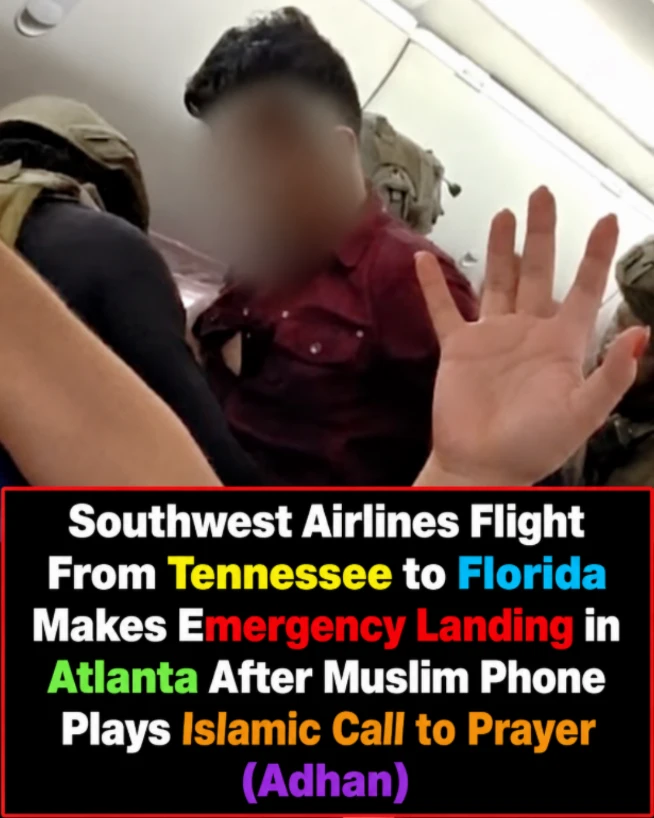
The incident occurred aboard Southwest Airlines Flight 2094 on the evening of March 6, 2026. Roughly half an hour after takeoff, the crew became concerned about a passenger whose phone unexpectedly played the Adhan, the traditional Islamic call announcing prayer time. According to later reports, the passenger had set a recurring prayer reminder on his phone because it was Ramadan, the holiest month in Islam, during which observant Muslims pray at specific times throughout the day.
To many Muslims around the world, hearing the Adhan is a normal part of everyday life. The Arabic recitation is heard from mosques five times each day and serves as a reminder that it is time for prayer. On an American commercial flight, however, the unfamiliar Arabic audio caught the attention of people nearby. Reports indicate that the passenger also began preparing to pray, and the combination of the unexpected sound and his behavior led some aboard the aircraft to fear there might be a security threat.
Flight attendants quickly notified the captain, who contacted air traffic control. Audio released after the incident showed controllers asking whether the concern involved a suspicious object or a suspicious passenger. The crew ultimately chose to treat the situation as a possible security matter rather than risk ignoring something that could endanger everyone on board.
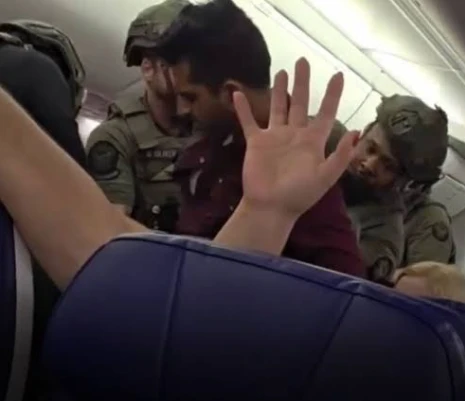
The aircraft diverted from its original route and headed for Hartsfield-Jackson Atlanta International Airport. While passengers were not initially given many details, videos later posted online captured tense moments inside the cabin. Flight attendants instructed everyone to keep their heads down and raise their hands while authorities prepared to board the aircraft after landing. Many passengers later described those moments as confusing and frightening because they did not know whether there was a bomb threat, a weapon on board, or some other immediate danger.
Shortly after the plane landed safely in Atlanta, tactical officers, local police, and federal agents boarded the aircraft. The Muslim passenger at the center of the incident was removed from the plane while other passengers remained seated. Officers also searched the aircraft and luggage as part of standard security procedures whenever a potential threat has been reported.
For the passengers watching the scene unfold, the response appeared to confirm their fears that a serious threat had existed. Some later shared videos showing officers moving through the cabin while passengers remained with their hands visible. Others described spending hours waiting as authorities completed their investigation before they were eventually transferred to another aircraft to continue their trip to Florida.
As investigators examined the situation, however, a very different picture emerged.
The FBI later announced that there was no credible threat connected to the passenger. Authorities determined that the incident stemmed from a misunderstanding involving a Ramadan prayer reminder on the passenger’s phone rather than any criminal act or terrorist plot. Federal officials confirmed that no charges would be filed against the passenger.

Southwest Airlines also characterized the event as a misunderstanding involving a customer’s behavior. The airline emphasized that the flight crew acted out of an abundance of caution because safety remains the company’s highest priority. While apologizing to passengers for the lengthy delay, Southwest praised the professionalism of its employees during a situation they believed could potentially involve a security risk.
The case has since sparked intense debate across social media and among civil rights advocates.
Many people defended the flight crew’s actions, arguing that airline employees have only seconds to make critical decisions when confronted with anything unusual. Since the September 11 attacks, commercial aviation has operated under strict security protocols that encourage crews to report and investigate anything that appears suspicious rather than dismiss it. Supporters of the crew argue that, even if the concern ultimately proved unfounded, failing to act on a genuine threat could have had catastrophic consequences.
Others viewed the incident very differently.
Muslim advocacy groups and many commentators questioned whether the passenger would have been treated the same way if the phone had played a church hymn, a ringtone in another language, or another unfamiliar sound. They argued that the episode illustrates how religious practices unfamiliar to some Americans can be misinterpreted as threats, leading to unnecessary fear, embarrassment, and public humiliation for innocent people.
The incident has renewed broader discussions about religious freedom, cultural awareness, and aviation security. Airlines operate in an environment where crews are expected to react quickly to anything that passengers perceive as dangerous. Yet critics say those same policies can unintentionally reinforce stereotypes if ordinary religious practices are mistaken for criminal behavior.
For the passenger involved, the experience was undoubtedly life-changing. Instead of quietly observing Ramadan during a routine flight, he became the focus of a major security operation involving police, tactical officers, and federal investigators—all because a prayer reminder sounded from his phone.
For everyone else aboard Flight 2094, it became a journey they are unlikely to forget. What started as a routine domestic flight ended with an emergency diversion, armed officers boarding the aircraft, passengers raising their hands, and hours of uncertainty before investigators finally concluded there had never been a genuine threat.
The incident also serves as a reminder of the difficult balance airlines face every day. Flight crews are expected to protect hundreds of lives while making rapid decisions with limited information. Sometimes those decisions prevent disasters. Other times, as investigators concluded in this case, they reveal how easily misunderstanding, fear, and heightened security can intersect.
Although the passenger was ultimately released without charges, the debate surrounding Flight 2094 continues. Some believe the crew did exactly what safety protocols required. Others believe the episode highlights the need for greater cultural understanding so that peaceful religious practices are not mistaken for acts of terrorism.
As more videos and witness accounts continue circulating online, one question remains at the center of the controversy: where should the line be drawn between necessary caution and a misunderstanding that forever changes an innocent passenger’s journey?