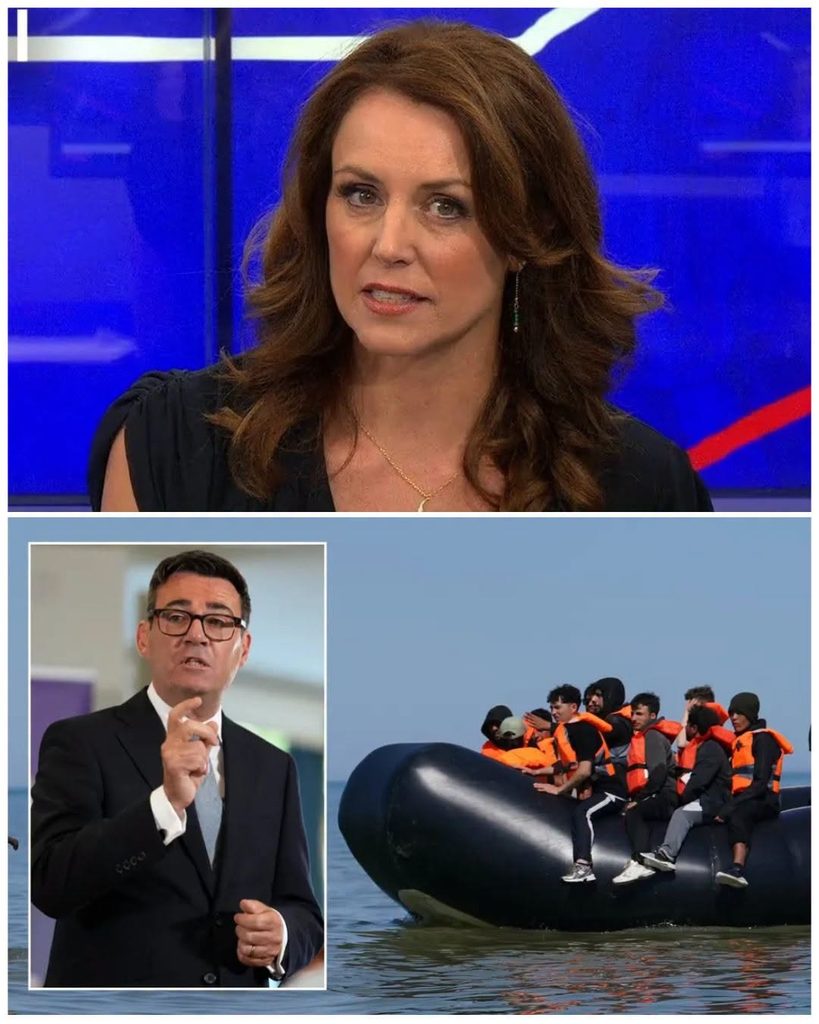
PM Andy Burnham was issued a warning on GB News after the latest migrant figures.
GB News came to a halt on Wednesday (25 November) as Bev Turner revealed that Europe’s migrant crisis had “hit another record”. Panning to footage from the Canary Islands, the presenter revealed that over 2,000 migrants travelling on 14 boats had arrived in one day. “The previous daily record was set just 10 days earlier,” Turner noted. “There are more migrants arriving in the Canaries right now than ever before. Only five days this month have seen no new arrivals. The president of the Canary Islands is now accusing African nations of failing to control their borders and stop the boats from leaving.
“It’s familiar, isn’t it? We say the same thing to the French, but why would they stop them from leaving?”
Launching into a rant, Turner fumed, “Just like here in Britain, the Spanish authorities welcome the migrants like prodigal sons, now including a four-star hotel near Malaga.
“It’s the same tsunami of men desperate for a different life at taxpayer expense that arrived in a Spanish enclave of Cueta just four months ago, remember?”
“In the weeks that followed, local women spoke of being too scared to leave their houses, and Spanish prosecutors reported 23 sexual assaults, including nine against children.
“There were also reports of attacks on police, shops being looted, homes being broken into, and even a local graveyard being used as a campsite and a public open-air toilet.”

Bev Turner warned Andy Burnham that migrants arriving in the Canaries are looking to Britain (Image: Getty)
As Turner reflected on the situation in Spain, the journalist warned that, for many migrants, “soft-touch Britain is in their sights”.
“If they do make it here, where will they be fed and rested?
Places like Piddington, of course, in the heart of the English countryside,” she mused.
Noting that this weekend, the Spanish election could see socialist Pedro Sánchez ousted from government, Turner concluded, “If so, we need to pay attention. Britain’s border security doesn’t begin and end at Dover. So, let’s hope our own prime minister is watching closely.”
Following the report, GB News viewers responded on X. “Burnham doesn’t care about the safety of women and children if he can get a few extra votes to keep him in power,” wrote one.
“Maybe he will do another TikTok video to stop them coming,” joked a second.
Andy Burnham Faces Intense Live Television Scrutiny Amid Explosive Immigration Debate
Immigration has become one of the most controversial political issues in Britain, generating intense discussions about national security, border control, public services and the future of British society. In recent years, the growing number of migrants arriving in the United Kingdom through irregular routes has increased pressure on the government to introduce more effective immigration policies. Andy Burnham has found himself at the centre of this debate, facing criticism and challenging questions about the government’s approach to migration. His appearance in a heated television discussion has attracted attention, highlighting the difficulties politicians face when attempting to balance humanitarian responsibilities with public concerns about immigration.
The immigration debate is particularly sensitive because it involves several complicated issues. On one hand, Britain has a long history of welcoming people escaping war, persecution, political instability and economic hardship. Many migrants hope to build safer and more prosperous lives in the country. They may contribute to the economy, fill vacancies in important industries and bring valuable cultural experiences to British communities. On the other hand, uncontrolled or poorly managed immigration can create significant challenges for housing, healthcare, education and local government services. Consequently, the government must develop policies that protect national interests while treating migrants fairly and respecting human rights.
One of the main concerns raised during discussions about immigration is the increasing number of people attempting to cross the English Channel in small boats. These dangerous journeys are frequently organised by criminal smuggling networks that exploit vulnerable individuals for financial gain. Migrants may pay substantial sums of money to smugglers who promise to transport them safely to Britain, despite the serious risks involved. Overcrowded boats, unpredictable weather and dangerous sea conditions can result in tragic accidents and loss of life. Therefore, tackling organised people-smuggling networks should be an important priority for the British government.
Supporters of stricter immigration controls argue that the government has a fundamental responsibility to protect its borders. They believe that a country must know who is entering its territory and ensure that immigration procedures are properly enforced. Effective border management can help identify individuals who may pose security risks, prevent criminal exploitation and maintain public confidence in the immigration system. From this perspective, politicians should provide clear explanations of their policies and demonstrate that they have practical strategies for reducing irregular arrivals.
During television discussions, politicians are often challenged to explain whether their policies are producing measurable results. Andy Burnham has faced questions concerning the government’s handling of migration and its commitments to reducing small-boat crossings. Such interviews illustrate how difficult it can be for political leaders to defend complicated policies when journalists demand immediate and straightforward answers. Immigration is not an issue that can be resolved through slogans or promises. It requires cooperation between government departments, international partners, law-enforcement agencies and local authorities.
Another controversial aspect of immigration concerns the accommodation provided to asylum seekers. When individuals arrive in Britain and submit asylum applications, the government must ensure that their cases are processed according to the law. However, delays in the asylum system can create additional financial pressure because people may need temporary accommodation while waiting for decisions. Hotels have sometimes been used to house asylum seekers, leading to criticism from local residents who believe that public money could be spent more effectively.
Communities hosting temporary accommodation facilities may also have concerns about pressure on local infrastructure. Residents may worry about the availability of healthcare appointments, school places, public transport and other essential services. They may also feel that decisions are being made without sufficient consultation. These concerns should not automatically be dismissed as hostility towards migrants. In a democratic society, citizens have the right to ask questions about government spending, local planning and the consequences of national policies for their communities.
Nevertheless, it is equally important to avoid blaming migrants collectively for problems that are often caused by wider economic and administrative failures. Most people seeking asylum are individuals attempting to escape difficult circumstances, and their legal claims must be assessed fairly. It would be inappropriate to assume that everyone arriving through an irregular route has criminal intentions. The government should distinguish between genuine refugees, economic migrants, individuals whose applications do not meet asylum requirements and organised criminal networks. A fair immigration system requires accurate information, individual assessments and consistent enforcement of the law.
The economic impact of immigration is another important part of the discussion. Migrant workers contribute to various sectors of the British economy, including healthcare, agriculture, construction, hospitality and social care. The National Health Service, for example, depends on employees from different countries who provide essential medical and support services. International workers can also help businesses address labour shortages, improve productivity and introduce specialised knowledge. For these reasons, immigration policy should consider the economic needs of the country rather than treating all forms of migration as a single problem.
At the same time, immigration does not automatically solve every labour-market difficulty. Employers must provide fair wages and acceptable working conditions, while the government should invest in training British workers and improving employment opportunities. If businesses become excessively dependent on overseas labour, there may be insufficient incentives to develop domestic skills. Therefore, a balanced immigration policy should combine appropriate recruitment from abroad with long-term investment in education, vocational training and workforce development.
The political consequences of the immigration debate are also considerable. Political parties frequently disagree about how strict immigration controls should be and how the country should cooperate with European governments. Some politicians advocate stronger border enforcement and faster deportation procedures for individuals without a legal right to remain. Others emphasise international cooperation, humanitarian protection and the need to address the circumstances that force people to leave their home countries.
These differences become particularly visible during live television interviews. Journalists may question politicians about previous statements, government decisions and apparent contradictions between political promises and practical outcomes. Such questioning is an essential part of democratic accountability. Politicians should be prepared to explain their decisions clearly, acknowledge difficulties and provide evidence to support their claims. Equally, television presenters should ensure that discussions remain accurate and that complicated issues are not reduced to emotional confrontations designed primarily to attract viewers.
The language used by newspapers and television programmes can also influence public perceptions. Headlines describing political appearances as humiliating defeats or explosive confrontations may attract attention, but they do not necessarily provide a complete account of what happened. An interview should be assessed by examining the actual questions, the politician’s answers and the available evidence rather than relying entirely on dramatic descriptions. Responsible journalism should distinguish between established facts, political criticism and personal opinions.
Another essential consideration is the importance of international cooperation. Britain cannot effectively address irregular migration through domestic policies alone. Many migration routes involve several countries, making cooperation with European governments and international organisations necessary. Information sharing, joint investigations, intelligence cooperation and coordinated action against smuggling networks could help reduce dangerous journeys. Britain should also work with countries of origin and transit to address the economic instability, conflict and insecurity that contribute to migration.
Furthermore, the asylum system should become faster and more efficient. Individuals with legitimate protection claims should receive decisions without unnecessary delays, while those who do not qualify under the relevant legal requirements should be dealt with through lawful procedures. Improving administrative capacity, employing adequately trained caseworkers and investing in modern information systems could help reduce backlogs. A faster system would benefit both applicants and British taxpayers by reducing the period during which people require temporary accommodation.
Ultimately, the immigration debate demonstrates the difficult choices facing the British government. Citizens expect secure borders, effective public services and responsible use of taxpayers’ money. At the same time, Britain has legal and humanitarian obligations towards people who genuinely need international protection. These responsibilities should not be presented as completely incompatible. A well-designed immigration system can protect national security, support economic development and provide fair treatment to vulnerable individuals.
In conclusion, Andy Burnham’s involvement in the immigration debate reflects the wider political tensions surrounding border control and asylum policy in modern Britain. Heated television discussions demonstrate the importance of transparency, accountability and clear communication in democratic government. However, meaningful solutions require more than political arguments or dramatic headlines. Britain needs effective border management, faster asylum decisions, stronger action against criminal smugglers, international cooperation and adequate investment in local communities. Most importantly, immigration policies should be based on reliable evidence, fairness and respect for human dignity. Only through a balanced and practical approach can the government address public concerns while maintaining Britain’s economic interests, democratic values and international responsibilities.